One of my favourite movies from the 1980's is Heavy Metal. I was 15 years old when it came out - just the right age to really appreciate animated nudity, and at the height of my D&D years, it proved to be a big influence on my gaming as well. I once created a campaign whose main villain was a priest of Set who carried a scepter with a glowing green orb that had the power to corrupt the souls of others: a not-too-subtle reference to the Loc-nar from Heavy Metal. I also often had the soundtrack from the movie playing while I planned adventures; in fact, I bought the Heavy Metal soundtrack on CD about a year ago and now often play it when I'm painting miniatures.
This evening I decided to spend the rainy night on the couch with a bowl of popcorn and watch Heavy Metal and was struck by a revelation that was probably obvious to everyone else who has ever seen the movie.
In the sequence entitled 'Den' by Richard Corben, shortly after Den arrives in Neverwhere he witnesses a priestess about to sacrifice a naked woman in a ritual to summon the god that sounds phonetically like Oo-la-tec. For some reason, it never occurred to me before, that this sounds an awful lot like Cthulhu backwards. A quick consultation with Wikipedia confirmed that Oo-la-tec is actually spelled 'Uhluhtc.'
I've never read much of Corben's Neverwhere comics and have only just discovered that they are heavily inspired by Howard's Hyborian Age, Burroughs's Barsoom, and Lovecraft's mythos. Now that I know, I'm going to have to try and track down the Neverwhere collections.
My wife has sometimes called me "the most unobservant person in the world" and if a Cthulhu-phile who has watched Heavy Metal as many times over nearly thirty years as I have can have missed the obvious reference to Cthulhu for so long, she may be right.
Welcome Back to the Labyrinth
"We have been away far too long, my friends," Ashoka declared, his face lit by the eldritch green glow of his staff. "But we have finally returned to the labyrinth whence our adventures first began."
"Just imagine the treasures that lie within," said Yun Tai, flexing his mighty muscles. "Wealth enough to live in luxury the rest of our days."
"And arcane artifacts of great power," added Ashoka his words dripping with avarice. "All ours for the taking!"
"Umm...guys?" Nysa interrupted. "Do you hear something dripping?"
Monday, May 24, 2010
Session 5: Gwyddno's Tomb
Having recovered from the harrowing adventure in the ruins of Gogledd Keep, the party felt they were finally ready to pursue the quest laid upon them by the sinister mage-priest, Frasck, to obtain an opalescent sphere from the renegade sorcerer, Sothiss.
Millenia past, a star fell from the sky, destroying the de Danann city of Murias, leaving only a massive crater in the Mac Morne Highlands. Some time later a dwarven expedition from Khelekdor began to excavate the crater for the star metal, known as Murian steel, which could be used to craft fantastic weapons and armour. After many years of excavation, shipments of Murian ore stopped arriving in Khelekdor, and the expedition was never heard from again. It was just at this time that treacherous dwarven Thanes rebelled against the Overking, resulting in the fall of Khelekdor and its seizure by the Horned Prince, Drufarodd and thus, the expedition to Murias was entirely forgotten in the wake of greater events.
It is within the dwarven mines of Murias, that Sothiss has made his lair and the party must seek out the renegade mage and slay him to absolve Jin's debt to Frasck.
The party followed the Ildanach River north for many days, into the highlands, on their way to the town of Glen Morag, the nearest settlement to the Crater of Murias. One night, the party's rest was disturbed by the unearthly howls of some type of beast in the distance. As the minutes passed the braying became louder and greater in number. Some manner of beasts were closing on the encampment. The party spent long minutes debating whether to flee or prepare to fight whatever was approaching. As the braying became louder and clearer, Caitlin blanched, recognizing the howls from Caemric folklore: darkhounds, the vanguard of the Wild Hunt. The party opted to run for some standing stones atop a distant tor, hoping that the sacred ground might ward them against the evil fey that now clearly had their scent.
The race was on. During their desperate run to the standing stones, the party chanced a look behind as they crested a hill, and saw, a mere half-mile behind them and closing quickly, a large pack of darkhounds, bestial phuka, and redcaps led by a pale rider on a black horse with flaming hooves. This frightening sight gave the party the desperate energy for the final push to the standing stones. Having reached the top of the tor, Theon and Bvar searched around the rocky outcrops for wood with which to build a bonfire, while Jin cast light spells on boulders to fully illuminate the tor for the fight to come. Suddenly, Bvar cried out and vanished. Rushing to where he was last seen, Theon found a hole that had crumbled beneath Bvar's feet, tumbling him unceremoniously down a steep slope into a dark cavern beneath the tor. The rest party squeezed through the hole, joining Bvar in the cavern below, and pulled a rock over the hole to hide it.
The cavern was, in fact an entry chamber to catacombs below the tor - possibly a funereal tomb for someone of importance. Ancient script of an unknown language was written on the chamber walls, and a narrow passage led from the chamber deeper into the catacombs. Following the passage, the party soon found that it branched in many directions. They opted to follow the southernmost branch and eventually found a door that was jammed shut. Throwing his weight heavily against the door, Bvar burst it open and stumbled into the room beyond and only his sharp reflexes saved him from falling to his death as a trap door concealing a deep, spike filled pit, opened beneath him. The room contained no less than sixty burial niches containing the mouldering remains of ancient warriors. The party thoroughly looted each of the niches and were enriched by the gold coins left for the dead to pay for their passage to the underworld as well as jewelry, an ancient greatsword, and a tattered banner that was later discovered to be the battle standard of The Thrice-Damned Legion that fought in the great de Danann War.
The party continued meandering their way through the catacombs, eventually proceeding down a long passageway ending in a stone-arch. Suspicious of further traps, Jin summoned an unseen servant to precede them down the passageway. Their suspicions were validated when, halfway down the passage, the unseen servant triggered a pressure plate in the floor. The party's precautions availed them little, however, as the pressure plate triggered a barrage of poisoned darts fired from the wall along the entire length of the passage. While Theon got his shield up to protect him from the darts, Bvar was struck in the neck, and Jin was punctured by three darts; the effects of the poison were felt immediately, weakening Bvar and Jin.
The stone arch at the end of the passage was inscribed with more of the unknown script, including a rune inscribe on stones on either side of the doorway. The chamber beyond the doorway contained a large stone sarcophagus with a lid carved in the likeness of a warrior. Arrayed around the sarcophagus were ten stone slabs, and upon each of which lay the ancient remains of warriors clad in mail hauberks and tattered red cloaks, clutching spears in their bony grasp. A fresco painted on the chamber walls depicted a king with a golden crown bearing sword and scepter standing atop a mound of enemies on a battlefield. The king was ringed by soldiers in red cloaks warding him with their spears against and advancing horde of phuka and redcaps. This scene was much like that described in the lay, The Last Ride of Gwyddno.
Again suspecting a trap, the unseen servant was sent ahead into the chamber, and once again the party's suspicions were justified. Just inside the door the servant triggered another pressure plate causing iron bars to drop from the archway, sealing the room. Bvar, despite his great strength, was unable to lift or bend the bars. Theon began pressing on stones in the doorway's arch, particularly the two runes inscribed on the sides. When one of the runes was pressed, the bars raised back into the archway. Careful to avoid the pressure plate the party entered the chamber, and Theon approached the pallet to inspect the remains of the warriors.
Suddenly warriors sat up, their empty eye sockets glowing with red light, then stood as one and advanced upon the intruders, spears at the ready. The party panicked at the sight of ten skeletal warriors bearing down upon them and Jin fled to the archway, triggering the reset trap, which dropped the bars once again, locking them in the tomb with the warriors. Theon called upon the grace of Lir and half of the undead warriors fled before him and cowered in the far corner of the tomb. The remaining five were quickly dispatched and the last five were also sent to their final rest.
Careful to avoid damaging the lid of the sarcophagus, a party member stood at each corner and they slowly lifted it off. As they did so, large blades scythed out from each side of the sarcophagus and thrust out at each end - all missing the characters who were standing just beyond the reach of the blades. Within the sarcophagus lay the remains of a king who bore a gold crown upon his head and an ancient bronze-hilted broadsword upon his chest. The scepter was no where within. Since the tomb appeared to have lain inviolate, and since the Lay of Gyddno described him buried with scepter and crown, they party reasoned that the scepter must be concealed within a secret compartment in the sarcophagus. Searching it carefully, they did find such a compartment containing the scepter of Gwyddno.
After completely looting everything of value from the tomb of the Llanvirnesse's first High King, the party left the catacombs in the safety of daylight and continued on their way to Glen Morag. Upon their arrival they took rooms at the local inn, and noted the odd looks that many of the town's residents gave them, pointing to many of the looted items openly displayed. Concerned that the locals would take them for tomb-robbers, the characters quickly retired to a single room and elected to stand watches through the night. Soon after they retired soldiers knocked on their door, telling the party that their chieftain, the king of Morag required their company at his manor.
Hastening to the chieftain's manor, the party met with King Cormac, who offered them refreshment and demanded to see the Caemric artifacts that they had found. The party showed him everything they found and Cormac immediately recognized the sword, crown and scepter of Gwyddno. He confiscated these items, offering the party gold, land and titles in recompense and additionally promised to outfit the party for their foray into the crater of Murias. An accord having been reached, the party spent the remainder of the night as guests in Cormac's manor and the next day an investment ceremony was held at which they swore to uphold Cormac as their liege in exchange for land and title in his realm.
Millenia past, a star fell from the sky, destroying the de Danann city of Murias, leaving only a massive crater in the Mac Morne Highlands. Some time later a dwarven expedition from Khelekdor began to excavate the crater for the star metal, known as Murian steel, which could be used to craft fantastic weapons and armour. After many years of excavation, shipments of Murian ore stopped arriving in Khelekdor, and the expedition was never heard from again. It was just at this time that treacherous dwarven Thanes rebelled against the Overking, resulting in the fall of Khelekdor and its seizure by the Horned Prince, Drufarodd and thus, the expedition to Murias was entirely forgotten in the wake of greater events.
It is within the dwarven mines of Murias, that Sothiss has made his lair and the party must seek out the renegade mage and slay him to absolve Jin's debt to Frasck.
The party followed the Ildanach River north for many days, into the highlands, on their way to the town of Glen Morag, the nearest settlement to the Crater of Murias. One night, the party's rest was disturbed by the unearthly howls of some type of beast in the distance. As the minutes passed the braying became louder and greater in number. Some manner of beasts were closing on the encampment. The party spent long minutes debating whether to flee or prepare to fight whatever was approaching. As the braying became louder and clearer, Caitlin blanched, recognizing the howls from Caemric folklore: darkhounds, the vanguard of the Wild Hunt. The party opted to run for some standing stones atop a distant tor, hoping that the sacred ground might ward them against the evil fey that now clearly had their scent.
The race was on. During their desperate run to the standing stones, the party chanced a look behind as they crested a hill, and saw, a mere half-mile behind them and closing quickly, a large pack of darkhounds, bestial phuka, and redcaps led by a pale rider on a black horse with flaming hooves. This frightening sight gave the party the desperate energy for the final push to the standing stones. Having reached the top of the tor, Theon and Bvar searched around the rocky outcrops for wood with which to build a bonfire, while Jin cast light spells on boulders to fully illuminate the tor for the fight to come. Suddenly, Bvar cried out and vanished. Rushing to where he was last seen, Theon found a hole that had crumbled beneath Bvar's feet, tumbling him unceremoniously down a steep slope into a dark cavern beneath the tor. The rest party squeezed through the hole, joining Bvar in the cavern below, and pulled a rock over the hole to hide it.
The cavern was, in fact an entry chamber to catacombs below the tor - possibly a funereal tomb for someone of importance. Ancient script of an unknown language was written on the chamber walls, and a narrow passage led from the chamber deeper into the catacombs. Following the passage, the party soon found that it branched in many directions. They opted to follow the southernmost branch and eventually found a door that was jammed shut. Throwing his weight heavily against the door, Bvar burst it open and stumbled into the room beyond and only his sharp reflexes saved him from falling to his death as a trap door concealing a deep, spike filled pit, opened beneath him. The room contained no less than sixty burial niches containing the mouldering remains of ancient warriors. The party thoroughly looted each of the niches and were enriched by the gold coins left for the dead to pay for their passage to the underworld as well as jewelry, an ancient greatsword, and a tattered banner that was later discovered to be the battle standard of The Thrice-Damned Legion that fought in the great de Danann War.
The party continued meandering their way through the catacombs, eventually proceeding down a long passageway ending in a stone-arch. Suspicious of further traps, Jin summoned an unseen servant to precede them down the passageway. Their suspicions were validated when, halfway down the passage, the unseen servant triggered a pressure plate in the floor. The party's precautions availed them little, however, as the pressure plate triggered a barrage of poisoned darts fired from the wall along the entire length of the passage. While Theon got his shield up to protect him from the darts, Bvar was struck in the neck, and Jin was punctured by three darts; the effects of the poison were felt immediately, weakening Bvar and Jin.
The stone arch at the end of the passage was inscribed with more of the unknown script, including a rune inscribe on stones on either side of the doorway. The chamber beyond the doorway contained a large stone sarcophagus with a lid carved in the likeness of a warrior. Arrayed around the sarcophagus were ten stone slabs, and upon each of which lay the ancient remains of warriors clad in mail hauberks and tattered red cloaks, clutching spears in their bony grasp. A fresco painted on the chamber walls depicted a king with a golden crown bearing sword and scepter standing atop a mound of enemies on a battlefield. The king was ringed by soldiers in red cloaks warding him with their spears against and advancing horde of phuka and redcaps. This scene was much like that described in the lay, The Last Ride of Gwyddno.
Again suspecting a trap, the unseen servant was sent ahead into the chamber, and once again the party's suspicions were justified. Just inside the door the servant triggered another pressure plate causing iron bars to drop from the archway, sealing the room. Bvar, despite his great strength, was unable to lift or bend the bars. Theon began pressing on stones in the doorway's arch, particularly the two runes inscribed on the sides. When one of the runes was pressed, the bars raised back into the archway. Careful to avoid the pressure plate the party entered the chamber, and Theon approached the pallet to inspect the remains of the warriors.
Suddenly warriors sat up, their empty eye sockets glowing with red light, then stood as one and advanced upon the intruders, spears at the ready. The party panicked at the sight of ten skeletal warriors bearing down upon them and Jin fled to the archway, triggering the reset trap, which dropped the bars once again, locking them in the tomb with the warriors. Theon called upon the grace of Lir and half of the undead warriors fled before him and cowered in the far corner of the tomb. The remaining five were quickly dispatched and the last five were also sent to their final rest.
Careful to avoid damaging the lid of the sarcophagus, a party member stood at each corner and they slowly lifted it off. As they did so, large blades scythed out from each side of the sarcophagus and thrust out at each end - all missing the characters who were standing just beyond the reach of the blades. Within the sarcophagus lay the remains of a king who bore a gold crown upon his head and an ancient bronze-hilted broadsword upon his chest. The scepter was no where within. Since the tomb appeared to have lain inviolate, and since the Lay of Gyddno described him buried with scepter and crown, they party reasoned that the scepter must be concealed within a secret compartment in the sarcophagus. Searching it carefully, they did find such a compartment containing the scepter of Gwyddno.
After completely looting everything of value from the tomb of the Llanvirnesse's first High King, the party left the catacombs in the safety of daylight and continued on their way to Glen Morag. Upon their arrival they took rooms at the local inn, and noted the odd looks that many of the town's residents gave them, pointing to many of the looted items openly displayed. Concerned that the locals would take them for tomb-robbers, the characters quickly retired to a single room and elected to stand watches through the night. Soon after they retired soldiers knocked on their door, telling the party that their chieftain, the king of Morag required their company at his manor.
Hastening to the chieftain's manor, the party met with King Cormac, who offered them refreshment and demanded to see the Caemric artifacts that they had found. The party showed him everything they found and Cormac immediately recognized the sword, crown and scepter of Gwyddno. He confiscated these items, offering the party gold, land and titles in recompense and additionally promised to outfit the party for their foray into the crater of Murias. An accord having been reached, the party spent the remainder of the night as guests in Cormac's manor and the next day an investment ceremony was held at which they swore to uphold Cormac as their liege in exchange for land and title in his realm.
Wednesday, May 19, 2010
Weird Wonder Wednesday: Opabinia
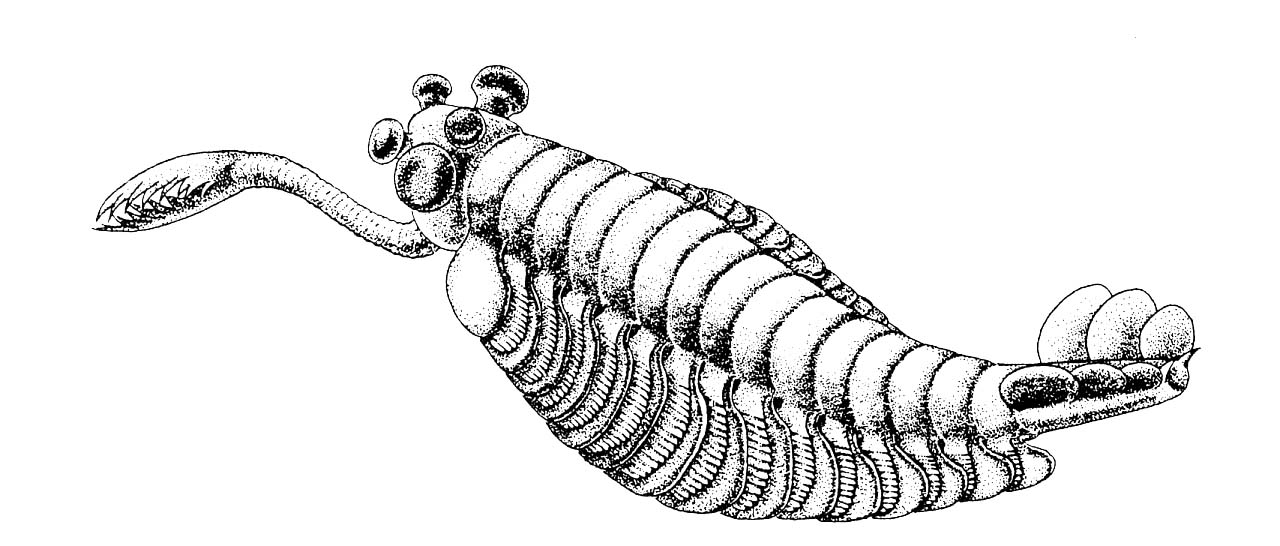
This week's 'weird wonder' is one of the strangest creatures ever to inhabit the earth, and one of my favourites: Opabinia.
Fossils of Opabinia regalis were first discovered from the Middle Cambrian Burgess Shale in Yoho National Park, British Columbia, Canada and were described by Charles D. Walcott in 1912.
Opabinia is distinguished by its five eyes at the front of its head and a long, flexible proboscis that bears an array of grasping spines at the end.
Fossilized specimen of Opabinia regalis
Opabinia is believed to have lived in soft sediment on the sea floor. It was an active predator that swam by using its lateral lobes for propulsion. The long proboscis is assumed to have been used to capture prey and transport it to the mouth located beneath the head. The proboscis might also have been plunged into the sediment to pull worms from their burrows.
The relationship of Opabinia to the rest of the animal kingdom is still unknown.
Fossils of Opabinia regalis were first discovered from the Middle Cambrian Burgess Shale in Yoho National Park, British Columbia, Canada and were described by Charles D. Walcott in 1912.
Opabinia is distinguished by its five eyes at the front of its head and a long, flexible proboscis that bears an array of grasping spines at the end.
Fossilized specimen of Opabinia regalis
Opabinia is believed to have lived in soft sediment on the sea floor. It was an active predator that swam by using its lateral lobes for propulsion. The long proboscis is assumed to have been used to capture prey and transport it to the mouth located beneath the head. The proboscis might also have been plunged into the sediment to pull worms from their burrows.
The relationship of Opabinia to the rest of the animal kingdom is still unknown.
Monday, May 17, 2010
Dancing in the Dark: Adaptations to a Lightless Environment
Since my current campaign is largely a dungeon delve, I've been giving a lot of thought lately to creatures that live in the darkness.
The very first adventure module I ever bought (but to this day, have never played) was D1: Descent into the Depths of the Earth, in which Gary Gygax introduced Drow to D&D. Right from the start there was something about evil, subterranean, demon-worshiping elves that appealed to me. But one thing about them has nagged me to this very day: why the heck do they have black skin?
Dark skin pigments are an adaptation to protect against ultraviolet radiation, which occurs naturally only in sunlight, and is in pretty short supply in the depths of the earth. Explaining it as an adaptation to provide camouflage doesn't hold much water, either; camouflage isn't of much use in a light-less environment.
The Drachmari, evil subterranean elves of the Unseelie Court, in my campaign look more like Elric of Melnibone or the mutants from The Omega Man than drow - pale skin, white hair and light-sensitive eyes. But old-schoolers are nothing, if not die-hard traditionalists, and I suspect that many would recoil in horror at the suggestion of non-black drow. So, how to explain black skin in a light-less realm? I suppose that one could say that the black skin is a manifestation of the drow's black hearts, or a sign of the favour of Lolth, or something like that. But I find that kind of rationalization unsatisfying and prefer a more naturalistic explanation. How about this: drow once dwelt on the surface, and evolved in a tropical, equatorial region of the world and subsequently adopted a subterranean lifestyle. Assuming that they consume a diet high in vitamin D, such as fish, it is possible that they could retain their dark skin pigment indefinitely despite the lack of ultraviolet radiation.
One of the reasons I like this explanation better than "they're black because they're evil," is that it reveals some interesting clues about the ecology of the drow: they originated in the tropics (and perhaps enclaves of them still dwell on the surface of their land of origin), and that they subsist largely on blind cavefish caught in subterranean lakes. I often find that knowing stuff like this fuels my imagination and helps with new adventure ideas.
Something else that I've been thinking about lately is the racial ability of "darkvision", or "deepvision" as it is called in Castles & Crusades. For some reason that is absolutely unfathomable to me infravision, which has long been an ability of subterranean races, such as dwarves, was replaced with "darkvision" in 3E, and it is utter nonsense. Darkvision is described as "black and white only, but it is otherwise like normal sight, and dwarves can function just fine with no light at all." Apparently Jonathan Tweet was sick the day they taught science at his school. Sight is the process by which photoreceptors (eyes) detect reflected light and transmit signals to the brain to decipher the appearance of illuminated objects. Without light, sight is not possible.
Now the concept of infravision makes a certain amount of sense - there are many animals that can see in the infrared spectrum and the idea of underground monsters in D&D with infravision is not all that far-fetched. Infrared radiation is simply light with a longer wavelength than that of radiation in the visible spectrum. Even so, while it might be useful for predators hunting prey in the dark, it would be of no use for navigating in the total darkness of the subterranean realm. So, really, infravision while possible is not the best adaptation for life in the dark.
Echolocation, such as possessed by bats is a far better adaptation for life in the dark. This type of active sonar involves the emission of high-frequency sounds, and ranging to objects is done by measuring the time delay between emitting the sound and any echoes reflected off of objects. Multiple receivers allow the animal to perceive its environment with great accuracy, and bats can snatch insects out of the air in total darkness. It seems to me that echolocation is a much better form of sensory perception for creatures that have evolved in a lightless environment. It is of more practical use than infravision, and more plausible than the absurd notion of "darkvision."
Consequently, I am removing Darkvision and its ilk from my games, entirely. As for dwarves, I'll be downgrading their eyesight to low-light vision, just like elves. It never made much sense to me that dwarves would be able to see in the dark, anyway. They are always depicted carrying torches and lanterns, and their halls are brightly lit. They are clearly not a species that evolved in total darkness and therefore should not be entitled to such adaptations merely because they choose to live underground.
The very first adventure module I ever bought (but to this day, have never played) was D1: Descent into the Depths of the Earth, in which Gary Gygax introduced Drow to D&D. Right from the start there was something about evil, subterranean, demon-worshiping elves that appealed to me. But one thing about them has nagged me to this very day: why the heck do they have black skin?
Dark skin pigments are an adaptation to protect against ultraviolet radiation, which occurs naturally only in sunlight, and is in pretty short supply in the depths of the earth. Explaining it as an adaptation to provide camouflage doesn't hold much water, either; camouflage isn't of much use in a light-less environment.
The Drachmari, evil subterranean elves of the Unseelie Court, in my campaign look more like Elric of Melnibone or the mutants from The Omega Man than drow - pale skin, white hair and light-sensitive eyes. But old-schoolers are nothing, if not die-hard traditionalists, and I suspect that many would recoil in horror at the suggestion of non-black drow. So, how to explain black skin in a light-less realm? I suppose that one could say that the black skin is a manifestation of the drow's black hearts, or a sign of the favour of Lolth, or something like that. But I find that kind of rationalization unsatisfying and prefer a more naturalistic explanation. How about this: drow once dwelt on the surface, and evolved in a tropical, equatorial region of the world and subsequently adopted a subterranean lifestyle. Assuming that they consume a diet high in vitamin D, such as fish, it is possible that they could retain their dark skin pigment indefinitely despite the lack of ultraviolet radiation.
One of the reasons I like this explanation better than "they're black because they're evil," is that it reveals some interesting clues about the ecology of the drow: they originated in the tropics (and perhaps enclaves of them still dwell on the surface of their land of origin), and that they subsist largely on blind cavefish caught in subterranean lakes. I often find that knowing stuff like this fuels my imagination and helps with new adventure ideas.
Something else that I've been thinking about lately is the racial ability of "darkvision", or "deepvision" as it is called in Castles & Crusades. For some reason that is absolutely unfathomable to me infravision, which has long been an ability of subterranean races, such as dwarves, was replaced with "darkvision" in 3E, and it is utter nonsense. Darkvision is described as "black and white only, but it is otherwise like normal sight, and dwarves can function just fine with no light at all." Apparently Jonathan Tweet was sick the day they taught science at his school. Sight is the process by which photoreceptors (eyes) detect reflected light and transmit signals to the brain to decipher the appearance of illuminated objects. Without light, sight is not possible.
Now the concept of infravision makes a certain amount of sense - there are many animals that can see in the infrared spectrum and the idea of underground monsters in D&D with infravision is not all that far-fetched. Infrared radiation is simply light with a longer wavelength than that of radiation in the visible spectrum. Even so, while it might be useful for predators hunting prey in the dark, it would be of no use for navigating in the total darkness of the subterranean realm. So, really, infravision while possible is not the best adaptation for life in the dark.
Echolocation, such as possessed by bats is a far better adaptation for life in the dark. This type of active sonar involves the emission of high-frequency sounds, and ranging to objects is done by measuring the time delay between emitting the sound and any echoes reflected off of objects. Multiple receivers allow the animal to perceive its environment with great accuracy, and bats can snatch insects out of the air in total darkness. It seems to me that echolocation is a much better form of sensory perception for creatures that have evolved in a lightless environment. It is of more practical use than infravision, and more plausible than the absurd notion of "darkvision."
Consequently, I am removing Darkvision and its ilk from my games, entirely. As for dwarves, I'll be downgrading their eyesight to low-light vision, just like elves. It never made much sense to me that dwarves would be able to see in the dark, anyway. They are always depicted carrying torches and lanterns, and their halls are brightly lit. They are clearly not a species that evolved in total darkness and therefore should not be entitled to such adaptations merely because they choose to live underground.
Saturday, May 15, 2010
Half-breed Races: A Biological Perspective
Half-breeds have been a part of D&D since the addition of half-elves in the 1976 Greyhawk supplement, which were probably inspired by the half-elven offspring of Luthien and Beren from Lord of the Rings. Half-breeds, however, raise some interesting and potentially awkward questions about the nature of a species. Even Tolkien tread carefully around this issue, and considered that elves needed to give up their immortality and live a mortal life if they were to marry a mortal. This was considered such a rare occurrence that there were only three such unions in all the ages. Tolkien further constrained the few half-elves resulting from the union of Luthien and Beren by forcing them to irrevocably choose which kindred to belong to. Elrond chose to be of Elvenkind, while his brother, Elros, chose to be of Mankind. Elros went on to found the kingdom of Numenor and give rise to the lineage from which Aragorn descended (so, yes, Aragorn married his cousin).
The problem with the half-breed is that the Biological Species Concept defines a species as a group of organisms that can interbreed, or potentially interbreed, and produce fertile offspring. Thus, from 1976 on, the implication has been that in D&D humans and elves are the same species. The situation became even more confused with the introduction of half-orcs, thus extending the concept of Homo sapiens to include not only humans and elves, but now orcs as well. The assumption made in D&D is that half breeds are the result of human and elven or human and orcish parentage, but since the species lines have been erased, it is just as likely to have half-breed offspring of orcish and elvish parentage.
While Tolkien handled the matter deftly, making interbreeding between the two species a divine gift of the Valar and a rare occurrence, 3E threw logic out the window with the proliferation of templates allowing one to create dire-fiendish-undead-half-mindflayers if you wanted (assuming you had the patience to work out the five-page-long stat block to accompany it).
So what? After all, Gary Gygax often reminded us that D&D was a game and we shouldn't get too hung up on realism. The thing is though, Gary also always kept one foot firmly planted in reality and was careful to balance good game mechanics with enough realism to create that all-important aspect of role-playing: suspension of disbelief.
For me suspension of disbelief is impossible without verisimilitude, which is achieved by imposing internally consistent natural laws that govern my campaign world. Those laws don't necessarily have to be those of the real world, but there ought to be some structure for how things work. It is perfectly acceptable to have races like half-elves and half-orcs, but I find it far more satisfying to consider the implications of such races and come up with a logical rationale for them.
Say we like both the half-elf and half-orc races and want to keep them. There are a few logical options to ponder:
A) Accept that all three races are, indeed the same species, and develop the world's history based on that assumption - what is their evolutionary history; how and when did they begin to develop such divergent racial traits? Furthermore, what geographical or morphological barriers are in place to restrict the proliferation of half-breeds and the otherwise inevitable convergence back into one homogenous race.
B) Imagine that humans, elves, and orcs are separate, but closely related species who can interbreed to produce infertile offspring, much like domestic horses, Equus ferus can interbreed with donkeys, Equus africanus, to produce infertile mules.
C) Humans, elves, and orcs are not closely related species and mating cannot produce offspring.
This is not to say that it is necessary to rationalize everything, but I find that at least considering the rationale behind elements of the milieu can open up some new perspectives that can help to shake of old cliches and result in a more original and dynamic campaign.
I created my own world of Faeridor about twenty years ago, long before I started thinking of such things and consequently I have had to retro-actively rationalize decisions that I sometimes regret. Half-elves are long-established in the campaign; the Mac Morne bloodline of Llanvirnesse is mingled with that of Sylvani royalty and the fertility of half-elves is unquestionable. Here, the rationale becomes sticky, because while the Sylvani are indigenous to Faeridor, humanity originated on Earth, with various tribes later transplanted to Faeridor by way of a dimensional rift. Thus, it would seem unlikely that two races from different dimensions would be genetically similar enough to produce viable offspring. The answer lies with the gods of man, the Tuatha de Danann who dwelt on Faeridor but dallied also on Earth. If humans and elves are both the by-product of the de Danann, then cross-breeding between the two races becomes better justified as they would share common ancestry.
Orcs, on the other hand, fulfill only a minor role in my world. They, too, are aliens brought to Faeridor by means of a dimensional rift, though in nowhere near the numbers that humans were. They serve as mercenary troops for any warlord who will give them coin and the chance to fight and are present in too few numbers to be a major menace. Consequently, the question of half-orcs has never arisen so it is easy enough to say that elves and humans cannot interbreed with orcs.
This is an inelegant explanation - the result of coming up with it after the fact, but I still find it more satisfying to know how the races came to be and how they relate to each other than simply to shoe-horn them in without considering the implications.
The problem with the half-breed is that the Biological Species Concept defines a species as a group of organisms that can interbreed, or potentially interbreed, and produce fertile offspring. Thus, from 1976 on, the implication has been that in D&D humans and elves are the same species. The situation became even more confused with the introduction of half-orcs, thus extending the concept of Homo sapiens to include not only humans and elves, but now orcs as well. The assumption made in D&D is that half breeds are the result of human and elven or human and orcish parentage, but since the species lines have been erased, it is just as likely to have half-breed offspring of orcish and elvish parentage.
While Tolkien handled the matter deftly, making interbreeding between the two species a divine gift of the Valar and a rare occurrence, 3E threw logic out the window with the proliferation of templates allowing one to create dire-fiendish-undead-half-mindflayers if you wanted (assuming you had the patience to work out the five-page-long stat block to accompany it).
So what? After all, Gary Gygax often reminded us that D&D was a game and we shouldn't get too hung up on realism. The thing is though, Gary also always kept one foot firmly planted in reality and was careful to balance good game mechanics with enough realism to create that all-important aspect of role-playing: suspension of disbelief.
For me suspension of disbelief is impossible without verisimilitude, which is achieved by imposing internally consistent natural laws that govern my campaign world. Those laws don't necessarily have to be those of the real world, but there ought to be some structure for how things work. It is perfectly acceptable to have races like half-elves and half-orcs, but I find it far more satisfying to consider the implications of such races and come up with a logical rationale for them.
Say we like both the half-elf and half-orc races and want to keep them. There are a few logical options to ponder:
A) Accept that all three races are, indeed the same species, and develop the world's history based on that assumption - what is their evolutionary history; how and when did they begin to develop such divergent racial traits? Furthermore, what geographical or morphological barriers are in place to restrict the proliferation of half-breeds and the otherwise inevitable convergence back into one homogenous race.
B) Imagine that humans, elves, and orcs are separate, but closely related species who can interbreed to produce infertile offspring, much like domestic horses, Equus ferus can interbreed with donkeys, Equus africanus, to produce infertile mules.
C) Humans, elves, and orcs are not closely related species and mating cannot produce offspring.
This is not to say that it is necessary to rationalize everything, but I find that at least considering the rationale behind elements of the milieu can open up some new perspectives that can help to shake of old cliches and result in a more original and dynamic campaign.
I created my own world of Faeridor about twenty years ago, long before I started thinking of such things and consequently I have had to retro-actively rationalize decisions that I sometimes regret. Half-elves are long-established in the campaign; the Mac Morne bloodline of Llanvirnesse is mingled with that of Sylvani royalty and the fertility of half-elves is unquestionable. Here, the rationale becomes sticky, because while the Sylvani are indigenous to Faeridor, humanity originated on Earth, with various tribes later transplanted to Faeridor by way of a dimensional rift. Thus, it would seem unlikely that two races from different dimensions would be genetically similar enough to produce viable offspring. The answer lies with the gods of man, the Tuatha de Danann who dwelt on Faeridor but dallied also on Earth. If humans and elves are both the by-product of the de Danann, then cross-breeding between the two races becomes better justified as they would share common ancestry.
Orcs, on the other hand, fulfill only a minor role in my world. They, too, are aliens brought to Faeridor by means of a dimensional rift, though in nowhere near the numbers that humans were. They serve as mercenary troops for any warlord who will give them coin and the chance to fight and are present in too few numbers to be a major menace. Consequently, the question of half-orcs has never arisen so it is easy enough to say that elves and humans cannot interbreed with orcs.
This is an inelegant explanation - the result of coming up with it after the fact, but I still find it more satisfying to know how the races came to be and how they relate to each other than simply to shoe-horn them in without considering the implications.
Thursday, May 13, 2010
Review: The Black Libram of Nartarus
When I came home this afternoon and found a parcel behind the screen door I clutched it gleefully to my chest and began to do a happy-dance, much like Gollum on the edge of Mount Doom when he finally got his 'precious.'
My precious, today, was a shipment from Paizo containing AEG's Ultimate Toolbox, and Troll Lord Games' The Black Libram of Nartarus. I'll have to put off reviewing Ultimate Toolbox until I've had more time to absorb the contents of that massive tome, but I've already given the Black Libram a read-through despite the risk to sanity and soul.
The Black Libram of Nartarus is a supplement for Castles & Crusades that introduces sword & sorcery-style dark magic and necromancy to the game.
Seventy-three black magic and necromantic spells are described from three profane tomes: The Black Libram of Nartarus, The Grimoire of the Witch Queen, and The Draconium of Kyuleshedrac. Not only does the inclusion of the tomes from which these spells originate recall the books of forbidden lore so familiar to fans of H.P. Lovecraft and R.E. Howard, but many of the spells, themselves, have names that drip with sword & sorcery flavour: Blades of Shambere, Cursed Rot of Medjedu, Ebon Bands of Binding, Guh-shun's Thorns of Anguish, Lassiter's Curse of the Serpent and they cry out to be used.
Guidelines are given to allow any spell casting class (including druids and illusionists) to tread the perilous path of necromancy. I find this particularly useful as druids in my campaign are not tree-hugging guardians of all creatures great and small, but wardens against the capricious and often terrifying forces of nature, and who routinely make blood sacrifice to appease Shub-Niggurath or Ithaqua. It would take little to push such grim adepts onto the path of darkness, raising an army of undead animals to do their bidding. In order to gain access to necromantic spells, a spell caster must state his intent to begin studying the dark arts at the beginning of the level preceding the one in which they would be able to cast spells of that level (i.e a caster wishing to gain access to 3rd level necromancy spells must begin studying at the beginning of 2nd level), an XP cost is added to the normal amount of experience needed to gain that level to reflect the extra study required. In a similar fashion, necromantic powers, such as the ability to Command Undead like a cleric, can be learned by a necromancer by stating his intent at the beginning of a level and paying an extra XP cost. He would then gain that ability at the start of his next level.
One of the best things about this book, in my opinion, is the chapter offering guidelines for sacrificial magic. I've always felt that the traditional magic system of D&D is not as sinister as I would like it to be, and I've long sought a way to incorporate blood sacrifice into the game. If you play in my campaigns you've probably lost track of the number of times you've rescued a naked woman bound to an altar, about to be sacrificed to a dark god. To quote Lovecraft: "It needed the nourishment of sacrifice, for it was a god, and the blood is the life. Even the Great Old Ones that are older than this world will answer a sorcerer's call when the blood of men or beasts is offered under the right conditions." Black Libram now offers a reason, beyond sword & sorcery genre convention, for putting all those women on altars to begin with. The guidelines for sacrificial magic increase the casting level of spells by a certain number of levels and for a certain number of hours depending on the hit dice of the victim. The blood can be taken from willing or unwilling recipients or even from animals, but animals provide the least benefit, while the greatest power is derived from the blood of the pure and the innocent. I'm pleased that I finally have the tools to tweak the magic system to what I thought it should always have been.
There is two pages of new magic items and artifacts, including the sacrificial dagger, that ubiquitous cultist accessory, that further increases the effectiveness of a blood sacrifice. Finally there is a chapter devoted to new monsters. My favourite of these are three new types of wolves: Ghoul Wolves, Shadow Wolves, and Vampiric Wolves. I found all three wolves disturbing and creepy, and the description of the Ghoul Wolf reminds me a great deal of the zombie hounds in the movie, Resident Evil.
I would be remiss if I didn't comment on the art. Both the cover and interior illustrations were made by Peter Bradley, and they set just the right tone for the book. The pages are scattered with numerous scantily clad women in perilous situations, dark tomes, and evil creatures. His illustration of the Vampiric Wolf depicts a sentient malice that I find unsettling in the best possible way.
I don't buy a lot of game products these days. I've been stung far too often by books and supplements that have disappointed me. All too often I flip through them and, uninspired, put them on the shelf where they languish ever after. I took a chance with Black Libram, and I didn't really expect much of it, but I was very pleasantly surprised. This is, quite simply, the best game supplement I've bought in years. Its twenty-eight pages are filled with lots of useful aids to help me inject more of the dark sword & sorcery flavour that I want into my game. Although it was written for Castles & Crusade it is, of course, completely compatible with any older version of D&D or its retro-clones. The book isn't perfect; anyone familiar with Castles & Crusades will be all too familiar with typographical errors and editing omissions, and Black Libram is no different. But this is a small complaint that in no way diminishes what is, in my opinion, an excellent game aid.
My precious, today, was a shipment from Paizo containing AEG's Ultimate Toolbox, and Troll Lord Games' The Black Libram of Nartarus. I'll have to put off reviewing Ultimate Toolbox until I've had more time to absorb the contents of that massive tome, but I've already given the Black Libram a read-through despite the risk to sanity and soul.
The Black Libram of Nartarus is a supplement for Castles & Crusades that introduces sword & sorcery-style dark magic and necromancy to the game.
Seventy-three black magic and necromantic spells are described from three profane tomes: The Black Libram of Nartarus, The Grimoire of the Witch Queen, and The Draconium of Kyuleshedrac. Not only does the inclusion of the tomes from which these spells originate recall the books of forbidden lore so familiar to fans of H.P. Lovecraft and R.E. Howard, but many of the spells, themselves, have names that drip with sword & sorcery flavour: Blades of Shambere, Cursed Rot of Medjedu, Ebon Bands of Binding, Guh-shun's Thorns of Anguish, Lassiter's Curse of the Serpent and they cry out to be used.
Guidelines are given to allow any spell casting class (including druids and illusionists) to tread the perilous path of necromancy. I find this particularly useful as druids in my campaign are not tree-hugging guardians of all creatures great and small, but wardens against the capricious and often terrifying forces of nature, and who routinely make blood sacrifice to appease Shub-Niggurath or Ithaqua. It would take little to push such grim adepts onto the path of darkness, raising an army of undead animals to do their bidding. In order to gain access to necromantic spells, a spell caster must state his intent to begin studying the dark arts at the beginning of the level preceding the one in which they would be able to cast spells of that level (i.e a caster wishing to gain access to 3rd level necromancy spells must begin studying at the beginning of 2nd level), an XP cost is added to the normal amount of experience needed to gain that level to reflect the extra study required. In a similar fashion, necromantic powers, such as the ability to Command Undead like a cleric, can be learned by a necromancer by stating his intent at the beginning of a level and paying an extra XP cost. He would then gain that ability at the start of his next level.
One of the best things about this book, in my opinion, is the chapter offering guidelines for sacrificial magic. I've always felt that the traditional magic system of D&D is not as sinister as I would like it to be, and I've long sought a way to incorporate blood sacrifice into the game. If you play in my campaigns you've probably lost track of the number of times you've rescued a naked woman bound to an altar, about to be sacrificed to a dark god. To quote Lovecraft: "It needed the nourishment of sacrifice, for it was a god, and the blood is the life. Even the Great Old Ones that are older than this world will answer a sorcerer's call when the blood of men or beasts is offered under the right conditions." Black Libram now offers a reason, beyond sword & sorcery genre convention, for putting all those women on altars to begin with. The guidelines for sacrificial magic increase the casting level of spells by a certain number of levels and for a certain number of hours depending on the hit dice of the victim. The blood can be taken from willing or unwilling recipients or even from animals, but animals provide the least benefit, while the greatest power is derived from the blood of the pure and the innocent. I'm pleased that I finally have the tools to tweak the magic system to what I thought it should always have been.
There is two pages of new magic items and artifacts, including the sacrificial dagger, that ubiquitous cultist accessory, that further increases the effectiveness of a blood sacrifice. Finally there is a chapter devoted to new monsters. My favourite of these are three new types of wolves: Ghoul Wolves, Shadow Wolves, and Vampiric Wolves. I found all three wolves disturbing and creepy, and the description of the Ghoul Wolf reminds me a great deal of the zombie hounds in the movie, Resident Evil.
I would be remiss if I didn't comment on the art. Both the cover and interior illustrations were made by Peter Bradley, and they set just the right tone for the book. The pages are scattered with numerous scantily clad women in perilous situations, dark tomes, and evil creatures. His illustration of the Vampiric Wolf depicts a sentient malice that I find unsettling in the best possible way.
I don't buy a lot of game products these days. I've been stung far too often by books and supplements that have disappointed me. All too often I flip through them and, uninspired, put them on the shelf where they languish ever after. I took a chance with Black Libram, and I didn't really expect much of it, but I was very pleasantly surprised. This is, quite simply, the best game supplement I've bought in years. Its twenty-eight pages are filled with lots of useful aids to help me inject more of the dark sword & sorcery flavour that I want into my game. Although it was written for Castles & Crusade it is, of course, completely compatible with any older version of D&D or its retro-clones. The book isn't perfect; anyone familiar with Castles & Crusades will be all too familiar with typographical errors and editing omissions, and Black Libram is no different. But this is a small complaint that in no way diminishes what is, in my opinion, an excellent game aid.
Wednesday, May 12, 2010
Weird Wonder Wednesdays: Anomalocaris
As a certain tormented Danish prince once said, "There are more things in heaven and earth, Horatio, than are dreamt of in your philosophy."
The longer I study the more I realize that truth is, indeed, stranger than fiction. These are bold words considering the weird and fantastic fiction that I enjoy, but true nonetheless. Last week I posted an essay entitled In the Oceans of Insanity on my natural history blog, Lore Deposits, exploring the influence that my exposure to the works of H.P. Lovecraft during my formative years had on the eventual course of my career path. I think that, perhaps, my discovery of Lovecraft in my teens imparted a life-long love of squama, tentacles, and multi-jointed appendages possessed by creatures that dwell within the ocean realm. In short, creatures so alien to our land-dwelling experience as to become the stuff of nightmares.
That being so, I thought it would be fun to begin a weekly series to share some of my favourite 'weird wonders' of the natural world. It is my hope that they might serve as inspiration for strange new creatures to introduce to your games. I don't intend to make any attempt to provide any game stats as I don't want to imprint my interpretations on anyone's imagination. If anyone does make anything of this, or any, of the creatures I describe in forthcoming articles, I'd love to hear about and see what you've come up with.
For the first few posts in the series we're going to travel back more than half a billion years into the past, when multicellular animals were undergoing widespread diversification in what has come to be known as the "Cambrian Explosion."
Anomalocaris
Often referred to as the 'King of the Cambrian,' Anomalocaris was an active predator and the largest animal to inhabit the Cambrian world, growing up to 0.5 metres long (approx 20 inches).
It swam above the seafloor hunting its prey, propelled by a series of lobes on either side of its body. It had two large appendages at the front of its head that were used to capture prey and transport food to its mouth.
The mouth consisted of a circular jaw that resembles a pineapple ring lined with teeth along the inside edge. The jaw functioned much like a nutcracker, breaking open the exoskeletons of its prey. It is thought to have eaten arthropods, and bite wounds in trilobite fossils have been interpreted as the work of Anomalocaris.
The first fossilized body parts of Anomalocaris were assumed to two different types of creature. The anterior appendages were thought to be shrimp, while the segmented discoid fossils that we now know to be the mouth was originally thought to be a jellyfish. It was, of course, reasonable to assign fossils to recognizable animal groups, but when Anomalocaris was finally reconstructed correctly, based on more complete specimens, it was truly a more bizarre creature than could possibly have been imagined.


The longer I study the more I realize that truth is, indeed, stranger than fiction. These are bold words considering the weird and fantastic fiction that I enjoy, but true nonetheless. Last week I posted an essay entitled In the Oceans of Insanity on my natural history blog, Lore Deposits, exploring the influence that my exposure to the works of H.P. Lovecraft during my formative years had on the eventual course of my career path. I think that, perhaps, my discovery of Lovecraft in my teens imparted a life-long love of squama, tentacles, and multi-jointed appendages possessed by creatures that dwell within the ocean realm. In short, creatures so alien to our land-dwelling experience as to become the stuff of nightmares.
That being so, I thought it would be fun to begin a weekly series to share some of my favourite 'weird wonders' of the natural world. It is my hope that they might serve as inspiration for strange new creatures to introduce to your games. I don't intend to make any attempt to provide any game stats as I don't want to imprint my interpretations on anyone's imagination. If anyone does make anything of this, or any, of the creatures I describe in forthcoming articles, I'd love to hear about and see what you've come up with.
For the first few posts in the series we're going to travel back more than half a billion years into the past, when multicellular animals were undergoing widespread diversification in what has come to be known as the "Cambrian Explosion."
Anomalocaris
Often referred to as the 'King of the Cambrian,' Anomalocaris was an active predator and the largest animal to inhabit the Cambrian world, growing up to 0.5 metres long (approx 20 inches).
It swam above the seafloor hunting its prey, propelled by a series of lobes on either side of its body. It had two large appendages at the front of its head that were used to capture prey and transport food to its mouth.
The mouth consisted of a circular jaw that resembles a pineapple ring lined with teeth along the inside edge. The jaw functioned much like a nutcracker, breaking open the exoskeletons of its prey. It is thought to have eaten arthropods, and bite wounds in trilobite fossils have been interpreted as the work of Anomalocaris.
The first fossilized body parts of Anomalocaris were assumed to two different types of creature. The anterior appendages were thought to be shrimp, while the segmented discoid fossils that we now know to be the mouth was originally thought to be a jellyfish. It was, of course, reasonable to assign fossils to recognizable animal groups, but when Anomalocaris was finally reconstructed correctly, based on more complete specimens, it was truly a more bizarre creature than could possibly have been imagined.

Anomalocarid appendage

The author, viciously assaulted by a life-size replica of Anomalocaris, at the Walcott Quarry in the Burgess Shale of Yoho National Park, British Columbia, Canada

Anomalocaris, King of the Cambrian
Subscribe to:
Posts (Atom)