Welcome Back to the Labyrinth

"We have been away far too long, my friends," Ashoka declared, his face lit by the eldritch green glow of his staff. "But we have finally returned to the labyrinth whence our adventures first began."

"Just imagine the treasures that lie within," said Yun Tai, flexing his mighty muscles. "Wealth enough to live in luxury the rest of our days."

"And arcane artifacts of great power," added Ashoka his words dripping with avarice. "All ours for the taking!"

"Umm...guys?" Nysa interrupted. "Do you hear something dripping?"

Monday, September 24, 2012

I am James T. Kirk

Sweet!
Now excuse me while I take my shirt off.

Your results:
You are James T. Kirk (Captain)
James T. Kirk (Captain)
70%
An Expendable Character (Redshirt)
65%
Will Riker
55%
Worf
50%
Beverly Crusher
45%
Leonard McCoy (Bones)
45%
Spock
42%
Geordi LaForge
40%
Jean-Luc Picard
40%
Mr. Sulu
35%
Chekov
35%
Deanna Troi
35%
Mr. Scott
25%
Data
15%
Uhura
15%
You are often exaggerated and over-the-top
in your speech and expressions.
You are a romantic at heart and a natural leader.
Click here to take the Star Trek Personality Test

Monday, September 17, 2012

Brushing Up on Painting

The enormously successful Reaper Bones Kickstarter has encouraged a great many people to take up the miniature-painting hobby.  The Reaper forums have seen a surge of new members; some who have gotten back into painting after a long hiatus, and others who have never painted a miniature in their lives.  Consequently there are lots of new painters with questions about what kind of brush to buy to what paints they'll need to get started, and I thought it might prove useful to share the sort of information that I wish I had when I got back into the hobby about seven or eight years ago.

It can, indeed, be a bit overwhelming when you're just getting started, and the up-front costs are substantial as well.  While you can build up your assortment of paints over time, you'll need a decent number to get you started, along with at least a few different brushes.

Since a craftsman is only as good as his tools, I believe that good brushes, as your paint-delivery-system, are of paramount importance in getting the most out of your miniatures.  It is all well and good to understand the techniques of painting, but if you can't apply the paint exactly where and how you want it, they won't do you any good.

Brushes come in a wide range of prices and qualities, from cheap craft brushes that cost a few dollars apiece to Kolinsky Sable brushes that run from twenty-five to thirty-five dollars each.  My advice here is simple: you get what you pay for, so buy the best brushes that you are able to afford.  The cheapest craft brushes, like the kind you can buy at Michael's may seem like a good deal, but they aren't; they will wear out very quickly and need to be replaced so often that your 'savings' will evaporate rather quickly.

What you want for painting miniatures are round tip water colour brushes.  These are commonly available with synthetic bristles, synthetic/sable blends (also known as 'gold sable'), and natural hair bristles (e.g. Kolinsky Sable).  I have brushes of all three types, and each has its uses.

Kolinsky Sable Brushes
Kolinsky Sable brushes are made from the tail hair from the winter coat of the Siberian weasel (Mustela sibirica).  They are the finest art brushes made and are superior to all other natural or synthetic bristles.  Because they don't breed well in captivity, the tail hair is widely-sought and, therefore, expensive.  But boy, oh boy, once you try painting with one you will know where your money went.  The fineness of the tips are unparalleled and allow you precise control and superior handling.  Upgrading to one of these fine brushes will elevate your painting to a new level and if you are serious about painting and can afford it, I strongly recommend purchasing at least one Kolinsky Sable brush for detail work at least.  They are also the most durable of bristles and, properly cared for, a Kolinsky Sable brush will outlast any other type of brush, serving you for years to come.

I use Winsor & Newton Series 7 brushes, mainly because they are the Kolinsky Sable brushes most readily available in Canada.  Another popular choice among serious miniature painters are Raphael 8404's, which I have long wanted to try, but have not been able to find in Canada and when I recently tried ordering some from the online retailer DickBlick.com I discovered that, due to U.S. Fish and Wildlife regulations, natural hair brushes cannot be shipped out of the U.S.A.
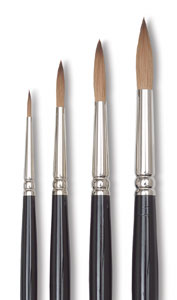
Winsor & Newton Series 7 pointed rounds
If you do invest in a set of Kolinsky Sable brushes, there are a few activities that I recommend you refrain using them for.  Obviously using them for rigorous painting techniques such as drybrushing or overbrushing should be avoided, but you should also avoid using them with metallic paint.  Metallic paint contains large metallic flakes that can damage the bristles and metallic paints also dry out much faster than normal acrylic paint, making it likely that paint will dry on the brush.  You should also avoid using them with washes because capillary action will draw the thin, watery wash up into the ferrule where, if it is allowed to dry, it will cause the point to separate, ruining the brush.  For these activities I use cheaper synthetic brushes.

Synthetic and 'Gold Sable' Brushes
Brushes with synthetic bristles or synthetic/sable blends (gold sable) are much less expensive than Kolinsky Sable brushes and can be had for less than ten dollars per brush.  Synthetic brushes are the least expensive, and I have a set of Grumbacher Goldenedge 4620 rounds that I use for base-coating, washing, and metallic paints that I don't want to subject my Winsor & Newtons to.  At about five dollars per brush, the Grumbachers offer decent value and last me about a year before needing replacement.  The Grumbacher Goldenedge bristles are made from Taklon fibre which is fairly durable and handles well, with a nice spring to it.  All synthetic brushes will develop a hook at the tip after a while and, assuming you paint with them regularly, a year is about the best you can hope for from them before the tip either hooks or separates.

Gold sable brushes contain mostly synthetic bristles with some sable mixed in.  They are relatively inexpensive, running about eight to ten dollars per brush and are often advertised as having the same performance as pure sable.  They don't.  They are also presumed to be more durable than synthetic, but the gold sable brushes I've tried haven't lasted any longer than the synthetics, so I'm not convinced that they are worth the extra cost.  Citadel paint brushes sold by Games Workshop, that many painters use, are synthetic/sable blends.  GW calls them Kolinsky Sable brushes, but this is outright prevarication.  Citadel brushes aren't horrible, as far as sythetic/sable blends go, and I believe that they are actually manufactured by Winsor & Newton, but Kolinsky Sable brushes they most definitely are not, and buyers should be aware that are not getting what is advertised.

Care and Feeding of Brushes
Not even the best brushes will last long if they aren't cared for, and whether you've bought a set of synthetic brushes or Kolinsky Sables, you'll want to prolong their lifespan by taking good care of them.  Here are a few tips to keep your brushes in top form:
1. Never leave them resting on their bristles in the water pot (this should go without saying).
2. Rinse them out frequently while you are painting.  This prevents paint from drying on the bristles.
3. Avoid getting paint in the ferrule.  To prevent this, dip only the tip of your brush in the paint.  Once paint drys in the ferrule you'll need to plan a trip to your art supply store for a new brush.
4. After your painting session wash your brushes thoroughly in cool water (never hot water) and reshape the point before putting them away.
5. Every now and again give your brushes a good washing with brush soap.  I use The Master's Brush Cleaner.  Don't use hand or dish soap on natural hair brushes, it will strip the oils from the bristles and destroy their suppleness.

What Sizes of Brush Should You Use?
This is a commonly-asked question and you will rarely need a smaller brush than a 00 or larger than a #2.  There will be one brush size that you prefer to do most of your painting with, but there is no conformity of size within the industry and one company's #1 will not be the same size as another company's #1.


The picture above shows three of my brushes.  The one on the left is a Winsor & Newton Series 7 #2, the red-handled brush in the middle is a Grumbacher Goldenedge #2, and the one on the right is a Winsor & Newton Series 7 #1.  You can see that the Grumbacher #2 is about the same size as a Winsor & Newton #1.  You should also be able to see the points on the Grumbacher and the W&N brushes.  I've used the W&N #1 far more than I've ever used the Grumbacher #2, but the point of the Kolinsky Sable is still pin-point sharp whereas the tip of the synthetic is not nearly so fine.

I do most of my painting with the Winsor & Newton #1; it has a large holding capacity and very fine point so I can paint both large areas and fine details with this one brush.  I use the W&N #2 mainly for big miniatures and large surface areas.  I also have a W&N 00 that I use for very fine details, such as eyes and the precision of its point allows me to paint pupils inside of irises and a light-spot across the pupil-iris boundary.  Some people like even smaller brushes, like a 000, but they hold so little paint that I can't see much use for them.  Ultimately, you'll have to decide for yourself what size of brush suits you best, but if you get a 00, 0, 1, and 2 you'll be well-set for any type of painting you want to do.

Where Should I Buy My Brushes?
I think part of the reason that so many people use Citadel brushes is that they are sold in most game stores where you buy your paints and miniatures.  But an art supply store is a better source for quality brushes at reasonable prices.  You can also buy brushes from many on-line retailers, including Amazon, and they often sell them for much less than you will pay in a brick and mortar store.  Indeed, DickBlick.com sells its brushes for about half the listed retail rate.  But there are a couple of things to keep in mind about buying brushes online: firstly, you can't examine the brush before you buy it, and this is important particularly if you are purchasing an expensive brush.  You always want to give it a good look-over to check the point and look for bent bristles.  If you order from an online retailer you are stuck with what they send you.  Another reason to beware buying online is that, as I mentioned above, sizes vary greatly among companies and, because brushes are hand-made, sizes can vary even within companies.  So you are often better off buying the brush personally so you can make sure that it is the size you want.

That about covers it.  The advice given here is based on my own experience, and I don't claim any special expertise.  Nonetheless, I do strongly feel that you should always buy the best quality brush that you can afford.  I've seen many people advise new painters to just buy cheap craft store brushes to start, but if you are serious about painting I think a good brush should be one of the first things you buy.  There is quite a learning-curve to painting, but starting out with the right tools will make that curve a little less steep.

Saturday, September 1, 2012

Bones Kickstarter Finale

Reaper's Bones Kickstarter project has ended with a whopping $3,429,236.00, making it the third most successful project in Kickstarter history.  The novelty of a gaming-related Kickstarter  project getting this kind of support turned a lot of heads and even warranted this article on Wired.com.

The pledges really took off in the final days of the campaign, unlocking even more cool stretch goals, which made the $100 Vampire level so attractive I just couldn't resist it.  Even though I couldn't really afford it, I couldn't afford NOT to up my contribution; a $100 pledge gets me over 240 miniatures.  This will keep me painting for a good long time.

Here's the image of all the swag with the last stretch goals added in:


Of particular interest to us Old School gamers, the perks include a free PDF of Frog God Games' Swords & Wizardry Complete.

If you're drooling over all this cool stuff, turning green with envy and kicking yourself for not jumping in, there's good news:  Reaper is setting up a post-Kickstarter pledge manager to allow people who missed out on the Kickstarter to still get in on the deal.  Simply click this link and submit your email, then Reaper will contact you when their post-Kickstarter pledge manager is up and running.

Monday, August 20, 2012

Bones Kickstarter Update

The Reaper Bones kickstarter is going great guns, and backers have pledged over a million dollars, which easily funds their initial goal of $30,000.  The kickstarter project will run for another five days, and if you haven't done so recently, check out their kickstarter page.  As the stretch goals have been met, Reaper has been adding more and more perks, which are jaw-droppingly fantastic and the rewards at the Vampire Level ($100 pledge) is unbelievable.  If there was any way I could afford it I would be in at this level and have enough miniatures to keep me painting for years to come.  As it is, I've ponied up $15 for the Ghast Level, which still gets me 36 miniatures.

They've also got a number of really cool add-on options available to all contributor levels:


I put in another $25 for the carrying case, which will hold over 100 miniatures, but the paint sets are a great deal, too.

So, if you've been on the fence about contributing, now is a great time to jump in while you still can.

Friday, August 17, 2012

City of the Beast - Against the Giants

Among the trove of Planet Stories books that I recently purchased was Michael Moorcock's City of the Beast.  Originally published in 1965 as Warriors of Mars, under the pen name Edward P. Bradbury, City of the Beast is a tribute to Edgar Rice Burroughs' Barsoom stories.


The premise of the story will be familiar to anyone who has read the adventures of John Carter: the protagonist Michael Kane, physicist, champion fencer, and Viet Nam veteran, tests an experimental matter transporter on himself and finds that instead of being transmitted to a receiver on the other side of his lab, he is sent through time and space to Mars in the distant past.  Almost immediately after his arrival, Kane espies the incomparable Dej... I mean the exquisite Shizala, princess of Varnala, who is clad in nothing but a wispy cloak and a broad leather belt around her waist and, of course, falls instantly in love with her.

Kane accompanies Shizala back to the city of Varnala where he receives a Matrix-style native language upload along with a healthy dose of exposition, including the backstory of how Shizala's father, the leader of Varnala disappeared while chasing off  an invading war band of blue-skinned giants called the Argzoon.

Later, while out riding alone, Kane spies an enormous horde of Argzoon headed toward the city, and he rushes back to warn the Varnalans so that they might prepare for the impending seige.  The city manages to hold off the first wave of attackers - just barely.  The discipline and tactics demonstrated by the Argzoon is uncharacteristic of the normally dim-witted and savage giants and it becomes apparent that they are being directed by some unknown leader.

Does any of this sound vaguely familiar to a D&D adventure you might once have played?

Kane proposes to assassinate this leader, assuming that the Argzoon horde will melt away without this great leader to drive them, and so Shizala pilots an aircraft over the Argzoon command tent and deposits Kane, who slays the war captain within, but disregards any complicity of a beautiful dark-haired woman named Horguhl who was also in the tent.  Because every one knows that beautiful women can't possibly be evil, or lead savage warbands in bids for global conquest.

Somehow, in all the confusion, Kane gets knocked unconcious and Shizala is taken captive and absconded with when the defeated Argzoon army retreats.  So Kane, along with Shizala's brother, Darnad, embark upon a rescue mission, ultimately tracking Shizala to the lair of the Argzoon, a subterranean mountain complex known as The Caves of Darkness.

Kane then sends Darnad for help and proceeds alone into the dungeons of the Argzoon.  Of course he is captured and taken before Horguhl who, unsurprisingly, is revealed to be the unknown mastermind.  It turns out that she is a former slave of the Argzoon who used her latent powers of compulsion to tame the dreaded N'aal Beast that dwelt within the Caves of Darkness, and intimidate the giants into following her.  She also professes to love Kane, and offers herself and kingship to him if he will join her, spiking the offer with some of those gnarly compulsion powers of hers.  Of course Kane, hero that he is, shrugs off the compulsion and spurns Horguhl's offer.  Hell hath no fury like a woman scorned, and so Horguhl has Kane tossed into the pit as a sacrifice for the N'aal Beast.  Kane slays the beast, whom the Argzoon believed was an avatar of their god, and when they see it die by his hands many of them question Horguhl's leadership.  Kane, meanwhile incites a revolt of the slaves who are led by none other than Shizala's missing father Carnak.  Horguhl's whole conquest plot starts to fall apart and she takes advantage of the confusion to get while the getting is good.

The maiden is rescued, Varnala is saved and Kane and Shizala are to become betrothed.  Just as Kane is about to live happily ever after, his lab assistants figure out how to get him back and he is suddenly whisked back to twentieth century Earth.

While City of the Beast covers no new ground, it is a fun and fast-paced action story that will appeal to fans of Burroughs as a sort extension of the John Carter stories.  What I found most intriguing was the notion of bands of giants harassing the land, led by a sinister overlord, which is much the same premise as we see in the popular G-series of AD&D modules, Against The Giants.


As Warriors of Mars was published in 1965, Gary may very well have read it and might have been influenced by it when writing the Giants adventures.  I also can't help but think that his imagination might have been peaked by the Argzoon's subterranean city in The Caves of Darkness.  It might also be a coincidence, but given Gary's voracious reading habits I find it entirely possible that he read this book and was, at least unconsciously, inspired by it.

Saturday, August 11, 2012

The Postman's Hernia

I mentioned last week, that Paizo is selling off most of their Planet Stories books for $3.  Well, my shipment arrived in the mail yesterday! This ought to keep me going for a while.


Thursday, August 9, 2012

Is the OSR Running Out of Steam?

If you are a regular OSR blog-follower, you've probably noticed a marked decline in posting frequency throughout the community.  During my first year or so of blogging I had so much to say it was hard to find time to write it all, and I and my peak I was posting a lengthy essay about every two days.  Now that I'm into year three, however, I'm finding it a struggle to make one post per week and only about half of those have any substantial content.  The others are lazy fluff pieces (e.g. my last two posts).

It's easy to make excuses: I'm busy, it's summer time and July's extreme heat sapped my will to live, and so on, but the real reason is that I'm finding it harder and harder to come up with anything interesting to say.  The curious thing is that it isn't just me burning out, this trend is pretty much pandemic across the OSR blogging community.  Once, not so long ago, I had to strictly limit the blogs that I followed and even then, such was the furious pace of posting, I had a hard time keeping up with them and if I didn't check my blog roll at least a couple of times a day, I missed posts.  Now I can skip a couple of days and find only a few new posts.

Even James Maliszewski, the Energizer Bunny of OSR blogging, is slowing down.  Of course, this is a relative observation; he's now 'only' posting at a frequency that equals or exceeds what I achieved at my peak instead of the unbelievably prolific two to three essay-length posts per day that we used to see on Grognardia.  James is also writing about gaming less these days and is more focused on reviews, and discussions of pulp fiction, suggesting that he, too, is running out of steam.  This is hardly surprising, and by no means a criticism.  I am amazed that he was able to sustain his posting rate for as long as he did.

Nonetheless, this community-wide slow-down is an interesting phenomenon.  Have we run out of things to say?  Is our great Renaissance losing momentum?  Or are we merely shifting our creative output to other fora?

My suspicion is that we are shifting our focus away from blogs and onto other media.  First message boards and then blogs were the principle venues of communication in the early years of the OSR, during the 'getting to know you' phase of the relationship, when we were passionately discussing old school gaming, sharing house-rules and posting myriad random tables.  But now we seem to have moved on to more sophisticated projects and blogs really aren't the best format for sharing them.  The honey-moon is over and it's time for this relationship to grow and mature.

There has been a lot of great material posted on people's blogs over the years, but it was read only by people who were following that blog at the time a particular article was posted.  Blogs are great for the immediate dissemination of information, but not for preserving and making material available over the long term.

So, I think - I hope - that much of the energy that the community used to put into blogging is now being directed at bigger projects that are being published as PDF or print products that won't languish in the obscurity of a blog archive.  New 'zines are springing up left and right, such as Tim Short's recent start-up, The Manor, and they contain much of what used to be posted on people's blogs.  This is probably a good thing, because back-issues will be available for a good long time, ensuring that past issues are readily available.  While I certainly miss the exciting hey-day of old school blogging, there is no way that level of output and energy could be sustained indefinitely.

So where does that leave blogs?  In my case it means doing what I originally intended when I first started this blog: posting session reports to create an ongoing history of my campaigns for player reference, posting house rules and, of course, letting off steam with occasional rants and musings, like this one.

I may be wrong, but I think that what we are seeing is not so much a decline or slow-down in the OSR, but rather a shift in how we do things as we mature and grow as a community.