I've long thought that roleplaying games would be an outstanding tool for museum programming and it turns out that some other visionary thought so, too, and actually made it happen.
The Royal Ontario Museum is hosting a Saturday morning D&D campaign for kids 11-14 years old, which utilizes material from the collections to teach kids about myths, monsters, and weapons of ancient cultures. Talk about a great way to bring history alive! I wish something like this had been around when I was a kid.

Saturday, December 1, 2012

Monday, October 29, 2012
Delving Deeper
I had the opportunity, this past weekend, to peruse the Delving Deeper rule books, which can be downloaded for free from RPGNow (Adventurer's Handbook, Referee's Guide, Monster & Treasure Reference). I was very impressed with what the authors, Cameron Dubeers and Simon J. Bull, have created. This is the most faithful reproduction of the original D&D rules that we have seen yet and it is very well-written and organized. Indeed, Delving Deeper is what D&D might have looked like if it had been written by J. Eric Holmes. What sets Delving Deeper apart from other retro clones is the clarity of its writing, and its effective organization and layout. Everything from the original three rule books, and more, is included and explained very clearly and simply, and the comprehensive table of contents makes it easy to quickly find the information you need.
 Volume 1: The Adventurer's Handbook is what one would expect, providing character classes, equipment and spells in a compact thirty-seven pages. The core classes: Fighter, Cleric, and Magic User are detailed, along with rules for Elves, Dwarves, and Halflings. The Thief is also presented as an optional class.
Following the character classes are some very useful guidelines for NPCs including Hirelings, Retainers, and Mercenaries, Loyalty and Morale, Monster NPCs and Relatives, including provisions allowing characters to bequeath their possessions to their next of kin so that in the all-too-likely event that they die, they can pass on their goods to their next character.
The equipment section is short and to the point, and includes useful guidelines for the weekly cost of a character's upkeep.
Following the spell descriptions are rules for spell research and enchanting magic items.

The Referee's Guide contains all the information that a game master needs to run a campaign in just twenty-nine pages, and is especially useful for first-time game masters; I found myself wishing I'd had this book when I was starting out. Following a short introduction to creating a campaign setting, there is an extensive section on dungeon creation, which includes an obligatory dungeon cross-section, and stocking tables for populating a dungeon on the fly, random dungeon encounter tables, trap tables, and a sample dungeon level.
Following the all-important guidelines for dungeon creation, are rules for underworld exploration and combat and, just like in the original little brown books, there are sections detailing wilderness exploration, seafaring exploration, and aerial exploration. These include random tables for detailing wilderness hexes, encounter tables for each environment, rules for overland, oceanic, and aerial movement as well as rules for evasion and pursuit. Taken as a whole these rules give you everything you need to run a hex-crawl campaign. The book ends with rules for constructing strongholds - something every player will want to do at some point.
The Referee's Guide is the real gem of Delving Deeper. The rules contained within set it apart from all other retro clones and as the name suggests, gives the game master the tools he needs to run his first campaign.
 In volume three, Delving Deeper has, again, taken its cue from the original source material and presented the monster statistics in tabulated form, followed by a chapter of monster descriptions that are free of game mechanics. This is how I like a monster book to be laid out. I dislike the Monster Manual-style of stat block followed by description for each monster entry, and much prefer descriptions to be separate from mechanics. The tables of monster statistics are easy to use in game, giving the game master all the monster information he needs at his finger tips without having to page through the whole book to look something up.
The monsters are followed by treasure tables and in similar fashion to the original rules, much space is devoted to magical swords, the sole province of the Fighter.
Though I've followed the development of Delving Deeper, I hadn't planned to buy it, content as I was and am, with Swords & Wizardry Whitebox. After reading the PDF's, however, I've changed my mind - I was pleasantly surprised by the high fidelity with which Delving Deeper emulates the original rules. I'm planning to soon begin a D&D campaign for my daughter who is now old enough to be introduced to the joys of role playing, and for several weeks I've been trying to decide which rule system to use. Now that I've seen Delving Deeper, my search is over; it is nearly the ideal game for introducing young children to the hobby, lacking only interior illustrations to capture a child's imagination. Consequently, these free PDFs have sold me on the game and I will soon be ordering a boxed set of my own.

Following the character classes are some very useful guidelines for NPCs including Hirelings, Retainers, and Mercenaries, Loyalty and Morale, Monster NPCs and Relatives, including provisions allowing characters to bequeath their possessions to their next of kin so that in the all-too-likely event that they die, they can pass on their goods to their next character.
The equipment section is short and to the point, and includes useful guidelines for the weekly cost of a character's upkeep.
Following the spell descriptions are rules for spell research and enchanting magic items.

The Referee's Guide contains all the information that a game master needs to run a campaign in just twenty-nine pages, and is especially useful for first-time game masters; I found myself wishing I'd had this book when I was starting out. Following a short introduction to creating a campaign setting, there is an extensive section on dungeon creation, which includes an obligatory dungeon cross-section, and stocking tables for populating a dungeon on the fly, random dungeon encounter tables, trap tables, and a sample dungeon level.
Following the all-important guidelines for dungeon creation, are rules for underworld exploration and combat and, just like in the original little brown books, there are sections detailing wilderness exploration, seafaring exploration, and aerial exploration. These include random tables for detailing wilderness hexes, encounter tables for each environment, rules for overland, oceanic, and aerial movement as well as rules for evasion and pursuit. Taken as a whole these rules give you everything you need to run a hex-crawl campaign. The book ends with rules for constructing strongholds - something every player will want to do at some point.
The Referee's Guide is the real gem of Delving Deeper. The rules contained within set it apart from all other retro clones and as the name suggests, gives the game master the tools he needs to run his first campaign.

The monsters are followed by treasure tables and in similar fashion to the original rules, much space is devoted to magical swords, the sole province of the Fighter.
Though I've followed the development of Delving Deeper, I hadn't planned to buy it, content as I was and am, with Swords & Wizardry Whitebox. After reading the PDF's, however, I've changed my mind - I was pleasantly surprised by the high fidelity with which Delving Deeper emulates the original rules. I'm planning to soon begin a D&D campaign for my daughter who is now old enough to be introduced to the joys of role playing, and for several weeks I've been trying to decide which rule system to use. Now that I've seen Delving Deeper, my search is over; it is nearly the ideal game for introducing young children to the hobby, lacking only interior illustrations to capture a child's imagination. Consequently, these free PDFs have sold me on the game and I will soon be ordering a boxed set of my own.
Monday, October 8, 2012
Crime and Punishment in Catapesh
If you are running a city-based campaign, as I am, and the player characters habitually wake up naked in jail, you will inevitably find yourself in need of some way of dispensing justice to your merry band of scoff-laws. It seems almost to be a universal rule that players + cities = trouble; there are just so many opportunities for mischief and it is the nature of players to exploit these to the fullest extent.
The following crime and punishment table is inspired by the one in Judge's Guild's City State of the Invincible Overlord, but has been customized to reflect life in the City States of Lemuria.
The outcome of a trial is determined by a d20 roll on Table 1. This roll is modified according to the severity of the crime, the magistrate's temperament, bribes, and the character's Charisma score (described on the modifiers tables, below). Once the outcome is determined, roll on the appropriate punishment table to determine the specific details.
MODIFIERS TO OUTCOME
(If subject is charged with multiple crimes, use the modifier for the most serious offense, then adjust it by -1 for each additional charge)
Severity of Crime Outcome Modifier
Dueling, Public Nuisance, Drunkenness +2
Bribery +1
Public Debauchery, Trespassing, Property Damage +0
Theft, Arson, Resisting Arrest, Extortion, Blackmail -1
Assault, Rape, Kidnapping, Tomb-Robbing, Piracy -2
Murder, Necromancy, Treason, Trafficking with Demons -3
Tax Evasion, Smuggling -4
Roll Magistrate's Temperament Outcome Modifier
1 'Hanging Judge' -4
2 'Tough on Crime' Crusader -3
3 Hung Over -2
4 Irritable -1
5 Scrupulously Impartial 0
6 Cheerful +1
7 Sympathetic +2
8 'Bleeding Heart' Reformer +3
Bribes Charged with Bribery Outcome Modifier
100 gp or more 15% +1
250 gp or more 10% +2
500 gp or more 05% +3
Charisma Outcome Modifier
Below Average -1
Average 0
Above Average +1
Table 1: OUTCOME OF TRIAL
Die Roll Outcome
1 or less Execution
2 Dismemberment
3-4 Imprisonment
5 Flogging
6 Enslavement
7 Indenture (roll on Jail table for duration)
8-9 Jail
10-11 Fine
12 Probation
13-17 Dismissal
18-20 Favourable Judgement
OUTCOME SUBTABLES (Roll for Result)
Execution Dismemberment
1. Beheading 1. Hand
2. Hanging 2. Foot
3. Impalement 3. Tongue
4. Sacrifice 4. Eye
Imprisonment Flogging (1d4 dmg per ten lashes)
1. Six Months 1. Ten Lashes
2. One Year 2. Twenty Lashes
3. Three Years 3. Fifty Lashes
4. Five Years 4. One-hundred Lashes
5. Ten Years 5. One-hundred and fifty Lashes
6. Twenty Years 6. Two-hundred Lashes
Enslavement to Indenture to
1. City Work Gang 1. City Work Gang
2. Galley Oarsman 2. Farm Work Gang
3. Mines 3. Mines
4. Gladiatorial Pit 4. Plaintiff
5. Brothel
6. Plaintiff
7. Overlord
8. Atlanteans
Jail Term Fine Amount
1. Ten Days 1. 10 gp
2. Thirty Days 2. 100 gp
3. Sixty Days 3. 500 gp
4. Ninety Days 4. 1,000 gp
5. Six Months 5. 5,000 gp
6. One Year 6. All Possessions
Probation
Roll on Jail table for period of probation. Guilty party may not bear arms or armour, and must report to the gaolers once per week.
Favourable Judgement
The accused is acquitted and receives financial compensation from the plaintiff. Roll on the Fine table to determine the amount of the award.
The following crime and punishment table is inspired by the one in Judge's Guild's City State of the Invincible Overlord, but has been customized to reflect life in the City States of Lemuria.
The outcome of a trial is determined by a d20 roll on Table 1. This roll is modified according to the severity of the crime, the magistrate's temperament, bribes, and the character's Charisma score (described on the modifiers tables, below). Once the outcome is determined, roll on the appropriate punishment table to determine the specific details.
MODIFIERS TO OUTCOME
(If subject is charged with multiple crimes, use the modifier for the most serious offense, then adjust it by -1 for each additional charge)
Severity of Crime Outcome Modifier
Dueling, Public Nuisance, Drunkenness +2
Bribery +1
Public Debauchery, Trespassing, Property Damage +0
Theft, Arson, Resisting Arrest, Extortion, Blackmail -1
Assault, Rape, Kidnapping, Tomb-Robbing, Piracy -2
Murder, Necromancy, Treason, Trafficking with Demons -3
Tax Evasion, Smuggling -4
Roll Magistrate's Temperament Outcome Modifier
1 'Hanging Judge' -4
2 'Tough on Crime' Crusader -3
3 Hung Over -2
4 Irritable -1
5 Scrupulously Impartial 0
6 Cheerful +1
7 Sympathetic +2
8 'Bleeding Heart' Reformer +3
Bribes Charged with Bribery Outcome Modifier
100 gp or more 15% +1
250 gp or more 10% +2
500 gp or more 05% +3
Charisma Outcome Modifier
Below Average -1
Average 0
Above Average +1
Table 1: OUTCOME OF TRIAL
Die Roll Outcome
1 or less Execution
2 Dismemberment
3-4 Imprisonment
5 Flogging
6 Enslavement
7 Indenture (roll on Jail table for duration)
8-9 Jail
10-11 Fine
12 Probation
13-17 Dismissal
18-20 Favourable Judgement
OUTCOME SUBTABLES (Roll for Result)
Execution Dismemberment
1. Beheading 1. Hand
2. Hanging 2. Foot
3. Impalement 3. Tongue
4. Sacrifice 4. Eye
Imprisonment Flogging (1d4 dmg per ten lashes)
1. Six Months 1. Ten Lashes
2. One Year 2. Twenty Lashes
3. Three Years 3. Fifty Lashes
4. Five Years 4. One-hundred Lashes
5. Ten Years 5. One-hundred and fifty Lashes
6. Twenty Years 6. Two-hundred Lashes
Enslavement to Indenture to
1. City Work Gang 1. City Work Gang
2. Galley Oarsman 2. Farm Work Gang
3. Mines 3. Mines
4. Gladiatorial Pit 4. Plaintiff
5. Brothel
6. Plaintiff
7. Overlord
8. Atlanteans
Jail Term Fine Amount
1. Ten Days 1. 10 gp
2. Thirty Days 2. 100 gp
3. Sixty Days 3. 500 gp
4. Ninety Days 4. 1,000 gp
5. Six Months 5. 5,000 gp
6. One Year 6. All Possessions
Probation
Roll on Jail table for period of probation. Guilty party may not bear arms or armour, and must report to the gaolers once per week.
Favourable Judgement
The accused is acquitted and receives financial compensation from the plaintiff. Roll on the Fine table to determine the amount of the award.
Monday, October 1, 2012
Session 14:
After a long summer hiatus we have resumed play where we left off: with the party enriched by an enormous trove of treasure recovered during their last foray into the catacombs beneath the necropolis. The subsequent night of celebratory debauchery ended with Ebbin naked in jail, and no idea how he got there.
The following morning Ebbin was hauled before a magistrate, hung-over and clad in a mildewed potato sack, charged with public drunkenness. The city watch testified that they found him passed out in a public fountain, but the magistrate was in a cheery mood and dismissed the case.
Concerned for the whereabouts of his armour, magic weapons and, most especially, his Gauntlets of Aten, Ebbin and his compatriots returned to the tavern where they had been drinking the night before, and the barkeep recalled that Ebbin left in the company of a dancing-girl named Sulma, who worked at a bawdy-house called Gilded Lilly's.
They found Sulma on stage at Gilded Lilly's, dancing for a small afternoon audience clad in naught but the tabard of a templar of Aten. Ebbin leaped onto the stage demanding the return of his gear and attempting to take back his tabard, but was grabbed and hauled bodily off the stage by a burly, looming Khurgani barbarian in the employ of the house. Sensing, correctly, that Ebbin was seconds away from picking a fight with the bouncer, Xuphor defused the situation by speaking to the proprietress, Lilly, who promised to speak to Sulma at the end of her set.
Sulma admitted to taking Ebbin's things after he passed out in the fountain, but only to 'keep them safe.' Unfortunately, on the way home she was accosted by a notorious loan shark named Haroun, and his thugs, who took all of it in payment for the 100 gp debt she owed him.
Their conversation was overheard by one of the patrons lurking in the nearby shadows, a guild-thief named Roary, who just so happened to owe money to Haroun, himself. Seizing the opportunity to eliminate his creditor and turn a profit in one stroke, Roary introduced himself and offered, for a small fee, to help the party ambush Haroun during his collection rounds. He led them through the maze-like tenements of the poor quarter, known by the locals as Hope's End, to a narrow alley-way where he was sure that Haroun was soon to pass. Sure enough, before long Haroun and his two body-guards did, indeed, enter the alley. The two guards fell in the ambush, but the cunning Haroun got past Xuphor and escaped into the labyrinthine streets of Hope's End.
Roary was sure that Haroun would retreat to the safety of his offices to gather reinforcements and urged the party to head directly there. Roary knew that Haroun had recognized him and feared that he would appeal to the master of the thieve's guild, in which case Roary would be in a great deal of trouble - the kind that ends with you floating face-down in the harbour. Thus, he was desperate to find and kill Haroun before he could squeal to the guild.
They arrived at Haroun's offices and found a couple of his henchmen waiting for them, but no Haroun, only an open trap-door in floor Haroun's warehouse, that led to the sewers. After dispatching the henchmen, the party descended into the sewers, but were promptly ambushed by a crocodile hiding beneath the surface of the water. When the croc was dead they noticed that it was tethered by a length of chain - the beast was obviously a guardian for Haroun's planned escape route. Xuphor, who stayed above to inspect the warehouse, found all of Ebbin's equipment lying in a pile awaiting liquidation. Giving up any hope of catching Haroun before he reached the Guild Master, the party decided to lay low for a awhile and head back down to the catacombs. It is telling commentary of one's lifestyle when an undead-packed dungeon is the safe alternative to remaining in the city.
Once in the catacombs, the party continued their exploration, but spent most of the rest of the session battering down bricked up doorways and attracting the attention of prowling Mongrel Men and Sapphire Skeletons. Just as they were about to call an end to their exploration and return to Catapesh to rest, the party discovered a narrow, crumbling passage-way and Roary decided to investigate it. When he disturbed the rubble he was swarmed by giant centipedes; he succumbed to their poisonous bites and died a horrible death, though perhaps not as horrible as the fate the the Thieves Guild had in store for him, so perhaps it was a blessing.
The remainder of the party returned to Catapesh and, as they were being sought by a vengeful Thieve's Guild, took the obvious course of action: a night of drinking and whoring at the nearest tavern! Ebbin sought ought Sulma for a quick tumble, then carried on with an evening of bacchanalian revelry that found him, in the morning....naked and in jail.
The following morning Ebbin was hauled before a magistrate, hung-over and clad in a mildewed potato sack, charged with public drunkenness. The city watch testified that they found him passed out in a public fountain, but the magistrate was in a cheery mood and dismissed the case.
Concerned for the whereabouts of his armour, magic weapons and, most especially, his Gauntlets of Aten, Ebbin and his compatriots returned to the tavern where they had been drinking the night before, and the barkeep recalled that Ebbin left in the company of a dancing-girl named Sulma, who worked at a bawdy-house called Gilded Lilly's.
They found Sulma on stage at Gilded Lilly's, dancing for a small afternoon audience clad in naught but the tabard of a templar of Aten. Ebbin leaped onto the stage demanding the return of his gear and attempting to take back his tabard, but was grabbed and hauled bodily off the stage by a burly, looming Khurgani barbarian in the employ of the house. Sensing, correctly, that Ebbin was seconds away from picking a fight with the bouncer, Xuphor defused the situation by speaking to the proprietress, Lilly, who promised to speak to Sulma at the end of her set.
Sulma admitted to taking Ebbin's things after he passed out in the fountain, but only to 'keep them safe.' Unfortunately, on the way home she was accosted by a notorious loan shark named Haroun, and his thugs, who took all of it in payment for the 100 gp debt she owed him.
Their conversation was overheard by one of the patrons lurking in the nearby shadows, a guild-thief named Roary, who just so happened to owe money to Haroun, himself. Seizing the opportunity to eliminate his creditor and turn a profit in one stroke, Roary introduced himself and offered, for a small fee, to help the party ambush Haroun during his collection rounds. He led them through the maze-like tenements of the poor quarter, known by the locals as Hope's End, to a narrow alley-way where he was sure that Haroun was soon to pass. Sure enough, before long Haroun and his two body-guards did, indeed, enter the alley. The two guards fell in the ambush, but the cunning Haroun got past Xuphor and escaped into the labyrinthine streets of Hope's End.
Roary was sure that Haroun would retreat to the safety of his offices to gather reinforcements and urged the party to head directly there. Roary knew that Haroun had recognized him and feared that he would appeal to the master of the thieve's guild, in which case Roary would be in a great deal of trouble - the kind that ends with you floating face-down in the harbour. Thus, he was desperate to find and kill Haroun before he could squeal to the guild.
They arrived at Haroun's offices and found a couple of his henchmen waiting for them, but no Haroun, only an open trap-door in floor Haroun's warehouse, that led to the sewers. After dispatching the henchmen, the party descended into the sewers, but were promptly ambushed by a crocodile hiding beneath the surface of the water. When the croc was dead they noticed that it was tethered by a length of chain - the beast was obviously a guardian for Haroun's planned escape route. Xuphor, who stayed above to inspect the warehouse, found all of Ebbin's equipment lying in a pile awaiting liquidation. Giving up any hope of catching Haroun before he reached the Guild Master, the party decided to lay low for a awhile and head back down to the catacombs. It is telling commentary of one's lifestyle when an undead-packed dungeon is the safe alternative to remaining in the city.
Once in the catacombs, the party continued their exploration, but spent most of the rest of the session battering down bricked up doorways and attracting the attention of prowling Mongrel Men and Sapphire Skeletons. Just as they were about to call an end to their exploration and return to Catapesh to rest, the party discovered a narrow, crumbling passage-way and Roary decided to investigate it. When he disturbed the rubble he was swarmed by giant centipedes; he succumbed to their poisonous bites and died a horrible death, though perhaps not as horrible as the fate the the Thieves Guild had in store for him, so perhaps it was a blessing.
The remainder of the party returned to Catapesh and, as they were being sought by a vengeful Thieve's Guild, took the obvious course of action: a night of drinking and whoring at the nearest tavern! Ebbin sought ought Sulma for a quick tumble, then carried on with an evening of bacchanalian revelry that found him, in the morning....naked and in jail.
Monday, September 24, 2012
I am James T. Kirk
Sweet!
Now excuse me while I take my shirt off.
Your results:
You are James T. Kirk (Captain)
Click here to take the Star Trek Personality Test
Now excuse me while I take my shirt off.
Your results:
You are James T. Kirk (Captain)
|
You are often exaggerated and over-the-top in your speech and expressions. You are a romantic at heart and a natural leader.  |
Monday, September 17, 2012
Brushing Up on Painting
The enormously successful Reaper Bones Kickstarter has encouraged a great many people to take up the miniature-painting hobby. The Reaper forums have seen a surge of new members; some who have gotten back into painting after a long hiatus, and others who have never painted a miniature in their lives. Consequently there are lots of new painters with questions about what kind of brush to buy to what paints they'll need to get started, and I thought it might prove useful to share the sort of information that I wish I had when I got back into the hobby about seven or eight years ago.
It can, indeed, be a bit overwhelming when you're just getting started, and the up-front costs are substantial as well. While you can build up your assortment of paints over time, you'll need a decent number to get you started, along with at least a few different brushes.
Since a craftsman is only as good as his tools, I believe that good brushes, as your paint-delivery-system, are of paramount importance in getting the most out of your miniatures. It is all well and good to understand the techniques of painting, but if you can't apply the paint exactly where and how you want it, they won't do you any good.
Brushes come in a wide range of prices and qualities, from cheap craft brushes that cost a few dollars apiece to Kolinsky Sable brushes that run from twenty-five to thirty-five dollars each. My advice here is simple: you get what you pay for, so buy the best brushes that you are able to afford. The cheapest craft brushes, like the kind you can buy at Michael's may seem like a good deal, but they aren't; they will wear out very quickly and need to be replaced so often that your 'savings' will evaporate rather quickly.
What you want for painting miniatures are round tip water colour brushes. These are commonly available with synthetic bristles, synthetic/sable blends (also known as 'gold sable'), and natural hair bristles (e.g. Kolinsky Sable). I have brushes of all three types, and each has its uses.
Kolinsky Sable Brushes
Kolinsky Sable brushes are made from the tail hair from the winter coat of the Siberian weasel (Mustela sibirica). They are the finest art brushes made and are superior to all other natural or synthetic bristles. Because they don't breed well in captivity, the tail hair is widely-sought and, therefore, expensive. But boy, oh boy, once you try painting with one you will know where your money went. The fineness of the tips are unparalleled and allow you precise control and superior handling. Upgrading to one of these fine brushes will elevate your painting to a new level and if you are serious about painting and can afford it, I strongly recommend purchasing at least one Kolinsky Sable brush for detail work at least. They are also the most durable of bristles and, properly cared for, a Kolinsky Sable brush will outlast any other type of brush, serving you for years to come.
I use Winsor & Newton Series 7 brushes, mainly because they are the Kolinsky Sable brushes most readily available in Canada. Another popular choice among serious miniature painters are Raphael 8404's, which I have long wanted to try, but have not been able to find in Canada and when I recently tried ordering some from the online retailer DickBlick.com I discovered that, due to U.S. Fish and Wildlife regulations, natural hair brushes cannot be shipped out of the U.S.A.
If you do invest in a set of Kolinsky Sable brushes, there are a few activities that I recommend you refrain using them for. Obviously using them for rigorous painting techniques such as drybrushing or overbrushing should be avoided, but you should also avoid using them with metallic paint. Metallic paint contains large metallic flakes that can damage the bristles and metallic paints also dry out much faster than normal acrylic paint, making it likely that paint will dry on the brush. You should also avoid using them with washes because capillary action will draw the thin, watery wash up into the ferrule where, if it is allowed to dry, it will cause the point to separate, ruining the brush. For these activities I use cheaper synthetic brushes.
Synthetic and 'Gold Sable' Brushes
Brushes with synthetic bristles or synthetic/sable blends (gold sable) are much less expensive than Kolinsky Sable brushes and can be had for less than ten dollars per brush. Synthetic brushes are the least expensive, and I have a set of Grumbacher Goldenedge 4620 rounds that I use for base-coating, washing, and metallic paints that I don't want to subject my Winsor & Newtons to. At about five dollars per brush, the Grumbachers offer decent value and last me about a year before needing replacement. The Grumbacher Goldenedge bristles are made from Taklon fibre which is fairly durable and handles well, with a nice spring to it. All synthetic brushes will develop a hook at the tip after a while and, assuming you paint with them regularly, a year is about the best you can hope for from them before the tip either hooks or separates.
Gold sable brushes contain mostly synthetic bristles with some sable mixed in. They are relatively inexpensive, running about eight to ten dollars per brush and are often advertised as having the same performance as pure sable. They don't. They are also presumed to be more durable than synthetic, but the gold sable brushes I've tried haven't lasted any longer than the synthetics, so I'm not convinced that they are worth the extra cost. Citadel paint brushes sold by Games Workshop, that many painters use, are synthetic/sable blends. GW calls them Kolinsky Sable brushes, but this is outright prevarication. Citadel brushes aren't horrible, as far as sythetic/sable blends go, and I believe that they are actually manufactured by Winsor & Newton, but Kolinsky Sable brushes they most definitely are not, and buyers should be aware that are not getting what is advertised.
Care and Feeding of Brushes
Not even the best brushes will last long if they aren't cared for, and whether you've bought a set of synthetic brushes or Kolinsky Sables, you'll want to prolong their lifespan by taking good care of them. Here are a few tips to keep your brushes in top form:
1. Never leave them resting on their bristles in the water pot (this should go without saying).
2. Rinse them out frequently while you are painting. This prevents paint from drying on the bristles.
3. Avoid getting paint in the ferrule. To prevent this, dip only the tip of your brush in the paint. Once paint drys in the ferrule you'll need to plan a trip to your art supply store for a new brush.
4. After your painting session wash your brushes thoroughly in cool water (never hot water) and reshape the point before putting them away.
5. Every now and again give your brushes a good washing with brush soap. I use The Master's Brush Cleaner. Don't use hand or dish soap on natural hair brushes, it will strip the oils from the bristles and destroy their suppleness.
What Sizes of Brush Should You Use?
This is a commonly-asked question and you will rarely need a smaller brush than a 00 or larger than a #2. There will be one brush size that you prefer to do most of your painting with, but there is no conformity of size within the industry and one company's #1 will not be the same size as another company's #1.

The picture above shows three of my brushes. The one on the left is a Winsor & Newton Series 7 #2, the red-handled brush in the middle is a Grumbacher Goldenedge #2, and the one on the right is a Winsor & Newton Series 7 #1. You can see that the Grumbacher #2 is about the same size as a Winsor & Newton #1. You should also be able to see the points on the Grumbacher and the W&N brushes. I've used the W&N #1 far more than I've ever used the Grumbacher #2, but the point of the Kolinsky Sable is still pin-point sharp whereas the tip of the synthetic is not nearly so fine.
I do most of my painting with the Winsor & Newton #1; it has a large holding capacity and very fine point so I can paint both large areas and fine details with this one brush. I use the W&N #2 mainly for big miniatures and large surface areas. I also have a W&N 00 that I use for very fine details, such as eyes and the precision of its point allows me to paint pupils inside of irises and a light-spot across the pupil-iris boundary. Some people like even smaller brushes, like a 000, but they hold so little paint that I can't see much use for them. Ultimately, you'll have to decide for yourself what size of brush suits you best, but if you get a 00, 0, 1, and 2 you'll be well-set for any type of painting you want to do.
Where Should I Buy My Brushes?
I think part of the reason that so many people use Citadel brushes is that they are sold in most game stores where you buy your paints and miniatures. But an art supply store is a better source for quality brushes at reasonable prices. You can also buy brushes from many on-line retailers, including Amazon, and they often sell them for much less than you will pay in a brick and mortar store. Indeed, DickBlick.com sells its brushes for about half the listed retail rate. But there are a couple of things to keep in mind about buying brushes online: firstly, you can't examine the brush before you buy it, and this is important particularly if you are purchasing an expensive brush. You always want to give it a good look-over to check the point and look for bent bristles. If you order from an online retailer you are stuck with what they send you. Another reason to beware buying online is that, as I mentioned above, sizes vary greatly among companies and, because brushes are hand-made, sizes can vary even within companies. So you are often better off buying the brush personally so you can make sure that it is the size you want.
That about covers it. The advice given here is based on my own experience, and I don't claim any special expertise. Nonetheless, I do strongly feel that you should always buy the best quality brush that you can afford. I've seen many people advise new painters to just buy cheap craft store brushes to start, but if you are serious about painting I think a good brush should be one of the first things you buy. There is quite a learning-curve to painting, but starting out with the right tools will make that curve a little less steep.
It can, indeed, be a bit overwhelming when you're just getting started, and the up-front costs are substantial as well. While you can build up your assortment of paints over time, you'll need a decent number to get you started, along with at least a few different brushes.
Since a craftsman is only as good as his tools, I believe that good brushes, as your paint-delivery-system, are of paramount importance in getting the most out of your miniatures. It is all well and good to understand the techniques of painting, but if you can't apply the paint exactly where and how you want it, they won't do you any good.
Brushes come in a wide range of prices and qualities, from cheap craft brushes that cost a few dollars apiece to Kolinsky Sable brushes that run from twenty-five to thirty-five dollars each. My advice here is simple: you get what you pay for, so buy the best brushes that you are able to afford. The cheapest craft brushes, like the kind you can buy at Michael's may seem like a good deal, but they aren't; they will wear out very quickly and need to be replaced so often that your 'savings' will evaporate rather quickly.
What you want for painting miniatures are round tip water colour brushes. These are commonly available with synthetic bristles, synthetic/sable blends (also known as 'gold sable'), and natural hair bristles (e.g. Kolinsky Sable). I have brushes of all three types, and each has its uses.
Kolinsky Sable Brushes
Kolinsky Sable brushes are made from the tail hair from the winter coat of the Siberian weasel (Mustela sibirica). They are the finest art brushes made and are superior to all other natural or synthetic bristles. Because they don't breed well in captivity, the tail hair is widely-sought and, therefore, expensive. But boy, oh boy, once you try painting with one you will know where your money went. The fineness of the tips are unparalleled and allow you precise control and superior handling. Upgrading to one of these fine brushes will elevate your painting to a new level and if you are serious about painting and can afford it, I strongly recommend purchasing at least one Kolinsky Sable brush for detail work at least. They are also the most durable of bristles and, properly cared for, a Kolinsky Sable brush will outlast any other type of brush, serving you for years to come.
I use Winsor & Newton Series 7 brushes, mainly because they are the Kolinsky Sable brushes most readily available in Canada. Another popular choice among serious miniature painters are Raphael 8404's, which I have long wanted to try, but have not been able to find in Canada and when I recently tried ordering some from the online retailer DickBlick.com I discovered that, due to U.S. Fish and Wildlife regulations, natural hair brushes cannot be shipped out of the U.S.A.
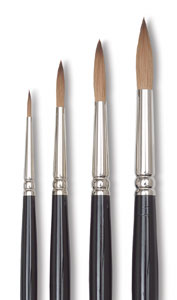 |
| Winsor & Newton Series 7 pointed rounds |
Synthetic and 'Gold Sable' Brushes
Brushes with synthetic bristles or synthetic/sable blends (gold sable) are much less expensive than Kolinsky Sable brushes and can be had for less than ten dollars per brush. Synthetic brushes are the least expensive, and I have a set of Grumbacher Goldenedge 4620 rounds that I use for base-coating, washing, and metallic paints that I don't want to subject my Winsor & Newtons to. At about five dollars per brush, the Grumbachers offer decent value and last me about a year before needing replacement. The Grumbacher Goldenedge bristles are made from Taklon fibre which is fairly durable and handles well, with a nice spring to it. All synthetic brushes will develop a hook at the tip after a while and, assuming you paint with them regularly, a year is about the best you can hope for from them before the tip either hooks or separates.
Gold sable brushes contain mostly synthetic bristles with some sable mixed in. They are relatively inexpensive, running about eight to ten dollars per brush and are often advertised as having the same performance as pure sable. They don't. They are also presumed to be more durable than synthetic, but the gold sable brushes I've tried haven't lasted any longer than the synthetics, so I'm not convinced that they are worth the extra cost. Citadel paint brushes sold by Games Workshop, that many painters use, are synthetic/sable blends. GW calls them Kolinsky Sable brushes, but this is outright prevarication. Citadel brushes aren't horrible, as far as sythetic/sable blends go, and I believe that they are actually manufactured by Winsor & Newton, but Kolinsky Sable brushes they most definitely are not, and buyers should be aware that are not getting what is advertised.
Care and Feeding of Brushes
Not even the best brushes will last long if they aren't cared for, and whether you've bought a set of synthetic brushes or Kolinsky Sables, you'll want to prolong their lifespan by taking good care of them. Here are a few tips to keep your brushes in top form:
1. Never leave them resting on their bristles in the water pot (this should go without saying).
2. Rinse them out frequently while you are painting. This prevents paint from drying on the bristles.
3. Avoid getting paint in the ferrule. To prevent this, dip only the tip of your brush in the paint. Once paint drys in the ferrule you'll need to plan a trip to your art supply store for a new brush.
4. After your painting session wash your brushes thoroughly in cool water (never hot water) and reshape the point before putting them away.
5. Every now and again give your brushes a good washing with brush soap. I use The Master's Brush Cleaner. Don't use hand or dish soap on natural hair brushes, it will strip the oils from the bristles and destroy their suppleness.
What Sizes of Brush Should You Use?
This is a commonly-asked question and you will rarely need a smaller brush than a 00 or larger than a #2. There will be one brush size that you prefer to do most of your painting with, but there is no conformity of size within the industry and one company's #1 will not be the same size as another company's #1.

The picture above shows three of my brushes. The one on the left is a Winsor & Newton Series 7 #2, the red-handled brush in the middle is a Grumbacher Goldenedge #2, and the one on the right is a Winsor & Newton Series 7 #1. You can see that the Grumbacher #2 is about the same size as a Winsor & Newton #1. You should also be able to see the points on the Grumbacher and the W&N brushes. I've used the W&N #1 far more than I've ever used the Grumbacher #2, but the point of the Kolinsky Sable is still pin-point sharp whereas the tip of the synthetic is not nearly so fine.
I do most of my painting with the Winsor & Newton #1; it has a large holding capacity and very fine point so I can paint both large areas and fine details with this one brush. I use the W&N #2 mainly for big miniatures and large surface areas. I also have a W&N 00 that I use for very fine details, such as eyes and the precision of its point allows me to paint pupils inside of irises and a light-spot across the pupil-iris boundary. Some people like even smaller brushes, like a 000, but they hold so little paint that I can't see much use for them. Ultimately, you'll have to decide for yourself what size of brush suits you best, but if you get a 00, 0, 1, and 2 you'll be well-set for any type of painting you want to do.
Where Should I Buy My Brushes?
I think part of the reason that so many people use Citadel brushes is that they are sold in most game stores where you buy your paints and miniatures. But an art supply store is a better source for quality brushes at reasonable prices. You can also buy brushes from many on-line retailers, including Amazon, and they often sell them for much less than you will pay in a brick and mortar store. Indeed, DickBlick.com sells its brushes for about half the listed retail rate. But there are a couple of things to keep in mind about buying brushes online: firstly, you can't examine the brush before you buy it, and this is important particularly if you are purchasing an expensive brush. You always want to give it a good look-over to check the point and look for bent bristles. If you order from an online retailer you are stuck with what they send you. Another reason to beware buying online is that, as I mentioned above, sizes vary greatly among companies and, because brushes are hand-made, sizes can vary even within companies. So you are often better off buying the brush personally so you can make sure that it is the size you want.
That about covers it. The advice given here is based on my own experience, and I don't claim any special expertise. Nonetheless, I do strongly feel that you should always buy the best quality brush that you can afford. I've seen many people advise new painters to just buy cheap craft store brushes to start, but if you are serious about painting I think a good brush should be one of the first things you buy. There is quite a learning-curve to painting, but starting out with the right tools will make that curve a little less steep.
Saturday, September 1, 2012
Bones Kickstarter Finale
Reaper's Bones Kickstarter project has ended with a whopping $3,429,236.00, making it the third most successful project in Kickstarter history. The novelty of a gaming-related Kickstarter project getting this kind of support turned a lot of heads and even warranted this article on Wired.com.
The pledges really took off in the final days of the campaign, unlocking even more cool stretch goals, which made the $100 Vampire level so attractive I just couldn't resist it. Even though I couldn't really afford it, I couldn't afford NOT to up my contribution; a $100 pledge gets me over 240 miniatures. This will keep me painting for a good long time.
Here's the image of all the swag with the last stretch goals added in:

Of particular interest to us Old School gamers, the perks include a free PDF of Frog God Games' Swords & Wizardry Complete.
If you're drooling over all this cool stuff, turning green with envy and kicking yourself for not jumping in, there's good news: Reaper is setting up a post-Kickstarter pledge manager to allow people who missed out on the Kickstarter to still get in on the deal. Simply click this link and submit your email, then Reaper will contact you when their post-Kickstarter pledge manager is up and running.
The pledges really took off in the final days of the campaign, unlocking even more cool stretch goals, which made the $100 Vampire level so attractive I just couldn't resist it. Even though I couldn't really afford it, I couldn't afford NOT to up my contribution; a $100 pledge gets me over 240 miniatures. This will keep me painting for a good long time.
Here's the image of all the swag with the last stretch goals added in:
Of particular interest to us Old School gamers, the perks include a free PDF of Frog God Games' Swords & Wizardry Complete.
If you're drooling over all this cool stuff, turning green with envy and kicking yourself for not jumping in, there's good news: Reaper is setting up a post-Kickstarter pledge manager to allow people who missed out on the Kickstarter to still get in on the deal. Simply click this link and submit your email, then Reaper will contact you when their post-Kickstarter pledge manager is up and running.
Subscribe to:
Posts (Atom)